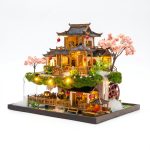



Miniature Tea House: A Builder’s Guide to Choosing Your Kit
A miniature tea house is more than a small model. It is a single, deliberate scene—a low table, a window onto a garden, the specific geometry of a tea set arranged on a tray. For the bookshelf builder, it often takes the form of a Book Nook insert, a world designed to fit in the 6-8 inches of space between your novels. This guide is for you if you know you want one on your shelf, but you need help choosing which one, and what the build actually involves.
What Defines a Miniature Tea House Scene?
Unlike a full miniature house kit with multiple rooms and floors, a tea house diorama focuses on a single, still moment. The core objects tell the story: a low chabudai table, zabuton cushions, a cast-iron tetsubin, and tiny ceramic cups. The architecture is the frame—perhaps shoji screen walls that let in pale light, or a view of a raked gravel garden.
The design challenge is compressing this sense of depth and tranquility into a narrow, vertical space. Every millimeter of perceived distance from the viewer to that far garden wall is designed. As we’ve found in our testing, the most effective kits use forced perspective, making the back of the scene smaller to create the illusion of space you don’t actually have. This is where a good beginner miniature house kit guide differs from a mediocre one—it solves the depth problem for you.
Choosing Your Style: Japanese, Chinese, or English?
Your first decision is aesthetic. This is about the feeling of the space you want to create.
- The miniature japanese tea house is an exercise in restraint. Think clean lines of light wood, tatami mats, and the careful emptiness of ma (negative space). The beauty is in the precision of the joinery and the texture of the paper screens. It is quiet and structured.
- The Chinese tea house often incorporates more ornamental lattice woodwork, round “moon gate” windows, and warmer tones—hanging lanterns, painted ceramics. There’s a focus on intricate detail and a sense of enclosed, inviting warmth.
- The English afternoon tea style leans into the cottagecore aesthetic. Here you’ll find floral patterns, a bay window seat, china cabinets, and perhaps trailing ivy. It connects to the same sensibility as a miniature greenhouse—a curated, slightly romanticized version of domestic comfort.
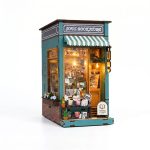
Look at the scenes. One will feel more like your bookshelf than the others.
Key Selection Criteria for Your DIY Miniature Tea House Kit
Once you’ve chosen a style, these are the practical filters. Start here.
- Scale & Footprint: Measure the gap on your shelf. Depth is the critical number. Most Book Nook tea houses are designed for a 6-8 inch (15-20 cm) depth. Check the product dimensions. Scale (1:12 vs. 1:24) affects how large the miniatures themselves are and whether third-party accessories will fit.
- Materials & Precision: Look for laser-cut basswood. Basswood is a light, fine-grained wood that cuts cleanly. The difference you feel is the snap-fit joinery—parts should click together with little force because the tolerances are tight (±0.1mm). MDF is heavier, duller, and often requires more glue and sanding.
- Difficulty & Realistic Time: Be honest with yourself. Tea house kits are typically rated Intermediate (~4-7 hours). However, the time on the box is optimistic. Based on builder feedback we track, you should add 30-40% to that number. A 5-hour declared kit is a 7-hour real-world build. We recommend planning to best split it across two sessions. The second session, after the glue has cured on the foundational structure, is almost always more enjoyable.
- Kit Contents (What’s In, What’s Not): Every Nookcraft kit includes an LED string light to illuminate the scene. Batteries are not included. You will also need your own super glue (cyanoacrylate) and basic tools like tweezers and a craft knife. The listing should state this clearly. Our full-color English photo instructions start at step 3—steps 1 and 2 are the workspace and tool setup we include that others often skip.
From Box to Bookshelf: What the Build Process Looks Like
Opening the box, you’ll find sheets of laser-cut parts still held in their wood frames, a bag of miniatures (your tea sets, cushions, plants), the LED wire, and the instruction manual.
Where builders most often get stuck is in the fine detailing—arranging the house miniature tea sets on a table that’s an inch wide, or threading the thin copper LED wire through a tiny anchor hole without bending it. These are the steps where instructions matter most. As we learned from testing with first-time builders, a poorly photographed step can cause a ten-minute stall. We redesign those sections with close-up callout arrows and multiple angles. The goal is to eliminate the “what changed from step 22 to 23” confusion.
The final step is always placement. You slide the finished piece into your chosen shelf gap. Then, in the evening, you turn on the little LED. The light comes through the shoji screen, or glows from the miniature lantern. You put your books back, leaving that one space for the scene. It’s not a moment we dramatize. It’s just a quiet thing that happens at the end of a project.
FAQ: Quick Answers for First-Time Builders
What is the difference between a miniature tea house and a regular miniature house kit?
A regular house kit is often about architectural construction—multiple floors, staircases, room divisions. A miniature tea house diorama is a scene focused on a single interior or interior-exterior view, designed as a self-contained moment, often optimized for a Book Nook insert between books.
How much space does a miniature tea house need on a bookshelf?
Measure your shelf gap. Most Book Nook kits are designed for a depth of 6-8 inches (15-20 cm). Always check the product’s listed dimensions (H x W x D) and compare them to your actual available space. A tight fit is good; a forced fit is not.
What glue do I need for a miniature tea house kit?
Super glue (cyanoacrylate) is the standard recommendation for laser-cut wood joints. It bonds quickly and strongly. A small tube is usually sufficient. It is not included in our kits to allow builders to use their preferred brand and type (gel vs. liquid).
Is this a good gift for someone?
Yes, for someone who enjoys focused, hands-on projects and has a place to display the result. It’s a screen-free activity that takes patience. We offer 30-day returns and free replacement parts for any missing or damaged pieces, which makes gift-giving less stressful if a small part gets lost.
Ready to find the one for your shelf? Browse miniature house kits for adults to compare styles, scales, and difficulty levels.