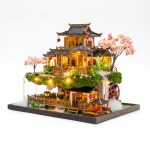



Miniature Conservatory: What to Check Before You Order a Kit
You’ve probably already scrolled through four or five kits. Maybe you have two tabs open, maybe seven. The miniature conservatory you’re picturing — glass walls, small plants, warm light pooling on a tiny wicker chair — exists in several versions, from several sellers, at several price points. The question isn’t whether you want one. The question is how to tell which version will actually look like that on your shelf.
This guide covers the five things I check when evaluating a miniature conservatory kit: material, piece count, lighting, assembly time, and display fit. These are the criteria that separate a kit you finish with satisfaction from one you finish with leftover parts and no clear explanation why.
What Makes a Conservatory Scene Different from Other Nature Kits
A miniature conservatory is not a greenhouse kit. It’s not a garden diorama either, even though they share some plant pieces. The visual structure is different enough to matter when you’re choosing.
Conservatory scenes emphasize enclosed glass-panel walls, thin iron-framing replicas, and curated indoor plant arrangements — ferns on stands, trailing vines along ceiling beams, a small table with a teacup. The architecture is the point. You’re looking into a room that happens to be made of glass and filled with plants. Greenhouse kits lean toward open structures with workbench elements: potting soil, seed trays, tools hanging from hooks. More workshop, less sitting room. Garden diorama kits go further outdoors — paths, fences, open sky.
Conservatory kits sit at the intersection of botanical and floral, greenhouse, and nature scene kits aesthetics. The visual reward is specific: warm LED light diffusing through translucent panel pieces, multiple layers of foliage creating depth, a sense that the shelf space has become a room you could step into. That reward is about what it looks like at 9 PM with the other lights off, not just what it looks like in a product photo.
If you’re choosing between several nature-themed kits, our full guide to floral, greenhouse, and nature scene kits covers the range — but a conservatory is specifically the enclosed, glass-walled, plant-filled room version. If that’s what’s been living in your browser tabs, the criteria below will help you narrow.
Wood, Cuts, and Why Material Matters More in Conservatory Kits
In most miniature kits, material quality is a general concern. In a miniature conservatory, it’s specific. The iron-frame replicas are thin — 2 to 4mm wide in most designs. The glass-panel frames have to align across multiple layers. The leaf pieces are small enough that a chipped edge is visible at arm’s length. Poor material doesn’t just affect durability here. It affects whether the pieces fit at all.
Basswood plywood vs. MDF. Basswood is light, fine-grained natural wood. It cuts cleanly, holds tight edges at small scale, and takes paint if you want to customize leaf tones or add patina to frames. MDF (medium-density fiberboard) is cheaper — heavier, with a uniform but flat surface that doesn’t take detail as well. At the thin frame widths conservatory kits require, MDF tends to chip along the cut edge. Not every kit that says “wood” uses basswood. Check the spec, not the marketing copy.
Laser-cut precision. Laser-cut basswood at ±0.1mm tolerance means snap-fit joints and clean alignment across layered pieces. For a conservatory where three or four frame layers stack to create the glass-panel structure, that tolerance is the difference between pieces lining up and pieces sitting slightly off — which you’ll notice every time you look at it.
If you’re building toward more complex scenes, the diorama kit guide for advanced scene building covers how material choices scale with complexity. But for a conservatory, the material question comes down to: basswood, laser-cut, ±0.1mm. Anything less, and the thin frame pieces will tell you.
Piece Count, LED Lighting, and What’s Actually in the Box
Conservatory kits tend to have higher piece counts than other kits of similar size. This isn’t padding — it’s because plant detail is dense. Each fern frond might be three to five separate pieces layered together. A hanging basket with trailing vines might be eight. Interior furniture adds more. Typical range: 150 to 350+ pieces.
Higher piece count means more foliage layers, which means more visual depth when it’s finished. It also means more time — but we’ll get to that.
What’s in every Nookcraft kit:What’s in every Nookcraft kit: laser-cut basswood pieces, a warm-white LED string with battery compartment, and full-color English photo instructions. The LED string is standard across all kits — it’s the piece that makes the finished conservatory glow through those glass-panel replicas in the evening.
What’s NOT in the box: batteries (CR2032 button cell), glue, and paint. This is the most common post-purchase surprise for first-time buyers. The battery is small enough that most people assume it’s packed in somewhere. It’s not. Glue and paint aren’t included because different builders prefer different adhesives and finishes — but you’ll need super glue (cyanoacrylate) at minimum.
The instruction manual matters more here than in most categories. Many competitors ship Chinese-only manuals or compressed-image step guides where the difference between step 22 and step 23 is hard to see. A buyer once emailed to say her LED stopped working on day three — she’d followed every step. When I traced it back, glue had seeped into the copper wire joint during final assembly. That one email changed our step 29 for every kit that followed: it now has a warning box that says keep glue away from wire ends, because contact causes intermittent failure. That’s the kind of instruction detail that only comes from building the kit multiple times and watching other people build it.
Every Nookcraft kit comes with 30-day returns and free replacement parts for missing or damaged pieces. If something arrives chipped or doesn’t fit, we replace it.
For more scene ideas across all categories, miniature design ideas covers 20+ themes and aesthetics.
Assembly Reality: Time, Skill, and the Steps That Catch People
I track assembly times. Not the box time — the real time. The declared time on most kits is the fastest a competent builder could go if nothing went wrong. In our experience, real assembly runs 30–40% longer than declared. So if a kit says 5 hours, plan for 7.
Conservatory kits tend toward intermediate-to-advanced difficulty due to the plant detail work. Nookcraft uses two difficulty levels:
- Intermediate: ~4–7 hours. Structure is straightforward, but plant layering and small furniture pieces require patience.
- Advanced: ~8–15 hours. More layers, more interior detail, more steps where precision matters.
We recommend splitting any conservatory build across two sessions. First session for the structure and frames — the walls, the glass-panel anchors, the base. Second session for plants, furniture, and LED wiring. The break gives glue time to set, and the second session is almost always more enjoyable because you’re not rushing through the foundational work.
Where people actually get stuck: We let three people who had never touched a miniature kit build the same model and recorded where they got stuck for more than ten minutes. The same two steps came up for all three — and in conservatory kits, the pain points are similar: threading LED wire through frame anchor holes, layering foliage pieces so they create depth instead of sitting flat, and gluing glass-panel replica frames without excess squeeze-out that shows through the translucent sections. The instructions weren’t wrong for those steps — they were written for someone who already knew what it was supposed to look like.
Ask yourself: do I have one long afternoon, or two shorter ones? If one, choose an intermediate kit at the lower end of the piece count range. If two, advanced kits are a different experience — slower, more detailed, with the kind of satisfaction that comes from getting a tricky section right on the second try.
For kits designed specifically to fit between books, Book Nook kits are worth knowing about — some conservatory scenes are designed in that format.
Where It Goes: Matching Your Conservatory to the Display Space
The finished piece test: I leave the room after completing a kit. Come back one minute later. If it still looks right, it ships. If I’m already seeing the thing I should have fixed, it doesn’t. The reason I do this is the same reason you should think about placement before you order — what a kit looks like depends on where it sits, what’s around it, and how much light hits it.
Between books. Some conservatory kits are designed as Book Nook inserts — you slide them between volumes and the glass-front scene creates the illusion of a room behind your shelf. Check your shelf gap: most need 4 to 6 inches minimum depth. Measure first.
Standalone on a shelf or desk. The glass-front conservatory design is meant to be viewed from the front. Face it forward with at least 6 inches of clearance in front. On a bookshelf, the top of the scene should sit below the shelf above it by at least an inch — you want to see the roof details and any hanging plant pieces.
LED placement. The warm-white LED string inside every kit creates the most visible effect in low ambient light. Consider a spot where you dim lights in the evening — a bedroom shelf, a living room side table, or a desk where you sit after dinner. The LED glow through the translucent panel pieces is the difference between “a nice model” and “the thing I show everyone who visits.”
Dust cover. Plant details — the tiny leaves, the vine tendrils, the fern fronds — collect dust faster than flat-surface scenes. If your shelf isn’t enclosed, a dust cover is worth the separate purchase. We sell them sized for each kit.
Frequently Asked Questions
What’s the difference between a miniature conservatory kit and a greenhouse kit?
Conservatory scenes emphasize enclosed glass-panel architecture with curated indoor plants and furniture — it’s a room that happens to be made of glass. Greenhouse kits tend toward open structures with workbench and potting elements — more workshop, less sitting room. Conservatory is display-oriented; greenhouse is more hands-in-the-soil oriented.
Do miniature conservatory kits come with everything I need?
Kits include laser-cut basswood pieces, an LED string with battery compartment, and full-color English photo instructions. Batteries (CR2032 button cell), glue, and paint are not included — you’ll need to source those separately. Every Nookcraft kit has 30-day returns and free replacement parts for missing or damaged pieces.
How long does it take to build a miniature conservatory kit?
Intermediate conservatory kits: 4–7 hours. Advanced kits: 8–15 hours. We recommend splitting the build across two sessions. In our experience, real assembly time runs about 30–40% longer than the declared time on the box — so plan accordingly.
Can I put a miniature conservatory between books on my shelf?
Yes, if the kit’s depth fits your shelf gap. Most Book Nook-style inserts need 4 to 6 inches minimum. Some conservatory kits are designed as shelf inserts; others are standalone display pieces meant to sit on top of or in front of books. Check the kit dimensions before ordering.
Browse our floral, greenhouse, and nature scene kits to find the right conservatory for your shelf.