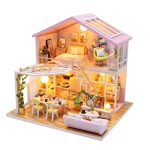
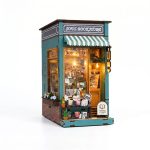
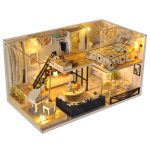
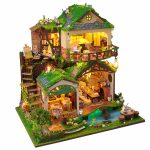
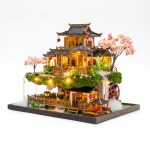



Miniature House Accessories: What’s Included, What’s Extra, and How to Choose
When you open a miniature house kit box, you’ll find walls, floors, and a roof — but that’s not what makes someone stop and lean in. The miniature house accessories inside the kit are what turn a wooden shell into a room that feels occupied. A tiny bookshelf with actual stacked books. A lamp on a side table. A pot on a stove burner. These are the pieces that give a scene its story, and they’re the reason most people buy a kit in the first place.
This guide covers what counts as a miniature house accessory, how accessories differ by scene theme, whether to buy them inside a kit or separately, and how to judge accessory quality before you commit. If you’re trying to figure out which kit will give you the richest interior without requiring you to hunt for extra pieces, this is where to start.
What Counts as a Miniature House Accessory
Accessories are the objects inside a miniature room that make it look lived-in — furniture, books, cups, plants, wall art, rugs, bottles, picture frames. They’re distinct from structural components, which are the walls, floors, ceilings, and roof pieces that form the skeleton of the build.
In a kit context, accessories are laser-cut and included in the box. The buyer assembles them as part of the build sequence, usually in the later steps after the structure is standing. A chair might be four snap-fit pieces. A stack of books might be three thin basswood sheets glued together with a paper spine wrap. Each one is a small construction project inside the larger one.
Separate miniature house accessories also exist — sold individually on Etsy, Amazon, or specialty shops. These work for experienced builders customizing a scene, but they introduce a problem: scale matching. A 1:12 chair from one seller might sit next to a 1:16 table from another, and suddenly the room looks wrong even if both pieces are well-made on their own.
I tested this once with three people who had never built a miniature kit. When I asked them to look at two finished scenes — one with consistent accessories from a single kit, one with mixed-sourced pieces — all three noticed the room contents first. Not the walls, not the roof. The objects on the table and the things on the shelves. As I’ve noted before: the first thing people notice when they see a finished miniature isn’t the miniature itself. It’s the room.
You can browse miniature house kits for adults that include pre-matched accessory sets — everything in the box designed to the same scale, same material, same visual language.
Accessories by Scene Theme: Fairy House, Dolls House, and Haunted House
Different scene themes call for different accessory types. If you’re searching for miniature dolls house accessories, miniature fairy house accessories, or miniature haunted house accessories, the aesthetic you want determines what should be inside the box.
Dolls House Accessories
These are scaled-down household items: kitchenware, books, lamps, armchairs, picture frames, dining tables, bathroom fixtures. The most common category in the miniature kit market. Scale consistency is the key criterion — at 1:12 scale, one inch equals one real foot. A mismatched teacup that’s clearly 1:16 next to a 1:12 dining table breaks the illusion immediately. When accessories come from a single kit, the designer has already solved this problem.
Fairy House Accessories
Botanical and whimsical elements: mushroom stools, vine ladders, mossy stones, lanterns, miniature flowers, tree-stump chairs. This category overlaps heavily with the Cottagecore aesthetic — a visual movement centered on rural cottage life, natural materials, and handmade textures. Fairy house accessories often pair with floral and greenhouse scenes. If that’s the look you’re after, our miniature greenhouse and floral kits cover this style with bundled botanical pieces.
Haunted House Accessories
Cobwebs, jack-o’-lanterns, flickering LED candles, gothic furniture, tiny potion bottles, broken shutters, miniature skulls. Niche buyer base, but dedicated. Lighting effects matter more here than in other themes — a haunted scene without shadow is just a dark room. The flicker of an LED string through a gothic window frame does most of the atmospheric work.
For more theme-specific inspiration across 20-plus scene types, see our miniature design ideas page.
Kit-Included vs. Separately Purchased Accessories
This is the core buying decision, and it comes down to three things: convenience, consistency, and cost.
A well-designed kit includes all accessories pre-cut and sequenced in the build. The instruction manual tells you exactly when to assemble the tiny bookshelf, when to place the LED wire behind it, and when to attach the wall art above it. No scale guessing. No ordering five items from five different sellers and hoping they arrive in the same week.
Buying separate accessories introduces three specific risks:
- Scale mismatch. One seller’s 1:12 might be another seller’s 1:10. Without measuring tools and a reference object, this is hard to catch before assembly.
- Material mismatch. A resin-cast lamp next to a laser-cut basswood table. Both look fine alone. Together, the texture difference is visible.
- Color inconsistency. Different manufacturers stain and finish wood differently. Natural basswood from two sources will have two different tones.
For experienced builders doing fully custom scenes, individual accessories from specialty sellers make sense — they have the tools and experience to adjust. For first-time builders, though, separate accessories add complexity without adding enjoyment. The better move is choosing a kit that already includes the accessory set you want.
Here’s what to look for in a kit’s accessory inventory:
- Piece count. Higher count means richer room detail. A 250-piece kit and a 400-piece kit might build the same room footprint, but the 400-piece kit has more shelf items, more wall art, more layered tabletop objects.
- LED lighting included. Every Nookcraft kit includes an LED string with battery compartment. It’s the accessory that transforms the finished piece from a static model into a scene with depth and shadow.
- Furniture that requires assembly. A solid pre-made chair block is cheaper to produce but gives the builder less involvement. Assembled-from-pieces furniture looks better and gives the builder the satisfaction of constructing something that small.
- Decorative items at multiple levels. Wall-mount items (frames, shelves), tabletop items (cups, books, bottles), and floor items (rugs, planters) create the visual layering that makes a room feel real.
For more guidance on choosing your first kit, see our beginner miniature house kit guide.
How to Judge Accessory Quality Before You Buy
Most kit listings show the finished scene from two feet away. That tells you almost nothing about the individual accessories inside. Here’s what to check instead.
Material. Laser-cut basswood at ±0.1mm precision is the standard to look for. Basswood has visible grain, accepts paint, and joints fit cleanly. MDF (medium-density fiberboard) is cheaper, heavier, and has a uniform surface that looks flat under close inspection. Injection-molded plastic is a third option — durable but visually different from wood. Each has its place, but mixing materials within one scene creates inconsistency.
Assembly type. Accessories that require assembly — snap-fit or glue — give the builder more control over the outcome and usually produce better-looking results than pre-assembled solid pieces. A tiny bookshelf built from six laser-cut pieces with snap-fit joints has real shadow lines and visible structure. A solid block that looks like a bookshelf from three feet away doesn’t.
Instructions. Full-color English photo instructions with callout arrows on accessory assembly steps are non-negotiable. In our testing with three first-time builders, the same two steps caused confusion for all three — not because the pieces were wrong, but because the instructions assumed they already knew what the result was supposed to look like. If the listing can’t show you clearly how a tiny accessory is built, the tiny accessory probably won’t look right in your hands either.
Close-up photos. Listings that show only a wide finished shot are hiding accessory detail. Sellers confident in their accessory quality show close-ups of individual pieces — the books on the shelf, the food on the plate, the plant in the pot.
Where to Start: Kits with Strong Accessory Sets
Different priorities lead to different kits. Here’s how to match what you want with what to look for.
Rich household-scale accessories. Look for kits with 300-plus pieces that include furniture assembly sequences — not pre-built furniture blocks. More pieces means more shelf clutter, more table items, more wall details. Intermediate kits (4–7 hours estimated assembly time) have fewer accessory layers than advanced kits (8–15 hours). The accessory richness scales with the difficulty level. Plan for best split across two sessions regardless of level — the declared time is usually the fastest a competent builder could go if nothing went wrong, so adding 30–40% gives a more realistic plan.
Botanical and whimsical accessories. Floral and greenhouse kits include miniature planters, vine elements, and textured greenery built into the scene design. These kits tend toward the Cottagecore aesthetic and pair well with bookshelf display.
Atmosphere through lighting. Every Nookcraft kit includes an LED string, but kits with multiple light anchor points create more dramatic shadow play inside the finished scene. One buyer told me her LED stopped working on day three — she’d followed every step. When I traced it back, glue had seeped into the copper wire joint at step 29. That’s why step 29 now has a warning box: keep glue away from wire ends. One email, one fix, still in the manual.
What if something arrives damaged? We offer 30-day returns and free replacement parts for missing or damaged pieces. If a tiny accessory arrives chipped, we replace it — you don’t need to return the whole kit. Every kit includes laser-cut basswood parts at ±0.1mm precision, full-color English photo instructions, and honest difficulty guidance so you know what you’re signing up for before you start.
If you’re looking for a kit where every accessory is already designed to fit, laser-cut, and sequenced in the build, browse all miniature house kits and find one that matches the scene you want on your shelf.
Frequently Asked Questions
What accessories come inside a Nookcraft miniature house kit?
Each kit includes laser-cut basswood furniture pieces (unassembled — you build them as part of the sequence), decorative items like miniature books, bottles, plants, and wall art, an LED string light with battery compartment, and all structural components. Everything is pre-cut and sequenced in the instruction manual. No separate ordering needed. Battery not included.
Can I add my own accessories to a kit after assembly?
Yes, but measure the finished interior first. Most Nookcraft kits use 1:12 or 1:24 scale — buying a third-party piece at the wrong scale is the most common mistake. Basswood accepts acrylic paint, so existing accessories can be repainted if you want them to match a new color scheme. A craft knife and tweezers help with placement in tight spaces.
What scale are miniature house accessories?
Most dollhouse kits use 1:12 scale (1 inch equals 1 real foot). Book Nook kits may use 1:24 or non-standard scales because they’re built to fit between books on a shelf — depth is constrained by the gap between your books, not by a standard ratio. Always check the kit listing for stated scale before buying separate accessories to match.
Do I need glue or tools for the accessories?
Super glue (cyanoacrylate) is recommended for wood joints — it’s not included in the kit, so you’ll need to supply your own. A craft knife and tweezers help with smaller accessory pieces. We don’t hide this in the fine print. The kit box and product page list what you need to have on hand before you start.
Ready to find a kit with the accessory set that fits your shelf? Browse miniature house kits →