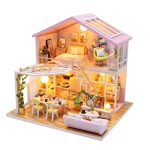
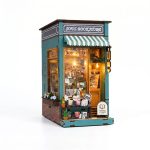
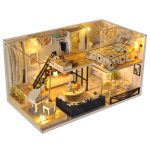
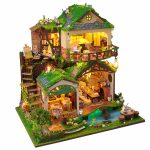
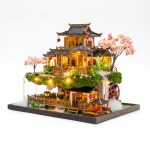



In the world of Kit Miniature House , scale seems to be everything. The allure of Kit Miniature House lies in the precise reproduction of every detail. However, as DIY miniature houses grow in popularity, a common question arises: “If my model and certain accessories are of different proportions, can they be mixed?” While maintaining consistent proportions generally makes the entire room appear more harmonious and realistic, in reality, many model enthusiasts often push these boundaries, expressing their individuality and creativity by mixing and matching accessories of varying proportions. So, can Kit Miniature House accessories of varying proportions be mixed and matched? There’s no definitive answer; it depends more on how you design and adjust them.
1. Definition and Importance of Proportion
If you ‘re new to Kit Miniature House , you might be confused by scale. Simply put, scale refers to the size of the model compared to the real object. Common scales include 1:12, 1:24, and 1:48. For example, a 1:12 scale means that every inch of the model is equivalent to 12 inches in real life. Scale not only determines the size of the house but also influences every detail—from furniture to curtains to decorations, everything needs to be in harmony with scale.
However, with the rise of the DIY spirit, more and more Kit Miniature House enthusiasts have begun to explore the mix and match of accessories of different sizes in their creations. This raises a question: if the proportions are inconsistent, can these accessories coexist in the same model?
2. Feasibility of Proportion Mixing
To answer this question, we need to consider it from multiple levels. After all, design is not just a question of vision and proportion. The actual user experience, functionality and personal creativity all play an important role in it.
2.1 Visual harmony: Does this look comfortable?
When the disparity in proportions is too great, mixed accessories often feel off. Placing a large sofa in a 1:12 scale room in a smaller one at 1:24 will instantly create a sense of imbalance and awkwardness. Even the most delicate details can lose their harmonious beauty due to a significant disparity in proportion.
However, the situation isn’t necessarily that simple. In fact, if you cleverly design the layout and adjust the layers and placement of accessories, you can achieve unexpected effects. For example, consider using 1:12 scale furniture as the main feature, while 1:24 scale accessories can serve as background decorations. By cleverly utilizing the layering of foreground and background, the visual disparity can be subtly mitigated.
2.2 Differences in details: more refined or more coarse?
Part of the allure of miniature homes lies in their attention to detail. Furniture at 1:12 scale is richly detailed and decorative, while accessories at 1:24 scale are typically much simpler. This difference in detail directly impacts the overall sense of harmony. If you mix and match the two, a significant disparity can make the design feel a bit awkward—some details appear overly refined, while others seem bland and ordinary.
Of course, the problem isn’t unsolvable. If you’re not striving for perfect proportions, mixing and matching can actually add some creativity to your design. For example, adding a few 1:24 scale kitchen accessories to a 1:12 scale kitchen won’t ruin the overall effect; instead, it can add depth to the space, creating a richer, more three-dimensional visual experience.
2.3 Functionality: The proportions are not appropriate. Can it be used normally?
Mixing and matching different scales isn’t just a visual challenge; practical functionality must also be considered. Imagine, for example, that a 1:12 scale kitchen appliance might not fit perfectly with a 1:24 scale small object. This could prevent some accessories from fitting into their intended locations, even impacting overall stability and usability. For example, while trying to fit a 1:48 scale lamp into a 1:12 scale room might not seem too dramatic, the disparity in scale could cause it to appear to “float,” rendering it impractical.
If the proportions differ too much, additional modifications and adjustments may be required to ensure the stability and aesthetics of the entire model. Therefore, when mixing and matching accessories of different proportions, how to ensure that they can fit into the space and work properly is an issue that cannot be ignored in your design.
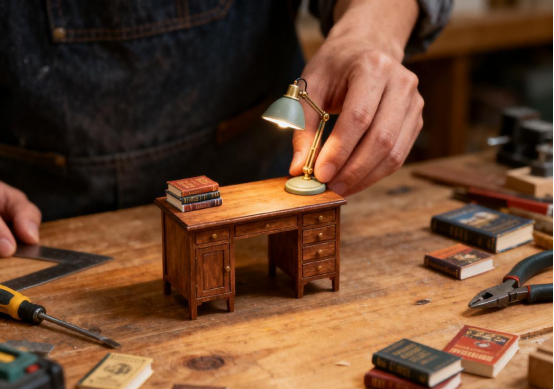
3. How to cleverly mix and match accessories of different proportions?
While the difference in proportions can present challenges, with proper design and adjustment, you can make these accessories coexist harmoniously. Here are some effective tips:
3.1 Using the layering of foreground and background
Cleverly utilizing foreground and background layers in design is the simplest and most effective way to mitigate scale discrepancies. For example, larger-scale items (such as a large sofa at a 1:12 scale) can be placed in the foreground, while smaller items (such as small ornaments at a 1:24 scale) can be placed in the background or the foreground. This way, the viewer’s visual focus remains on the primary item, and the scale discrepancy becomes less abrupt.
3.2 Enhance contrast: Make proportional differences the highlight
You can enhance the contrast created by differences in scale to create a sense of creative tension. For example, placing a large-scale object in a prominent position while using smaller items as decoration can break up the sense of routine in a space and create a more impactful effect. This approach is often used in modern and futuristic designs, allowing for a break from tradition and a personal touch.
3.3 Use small accessories as decoration
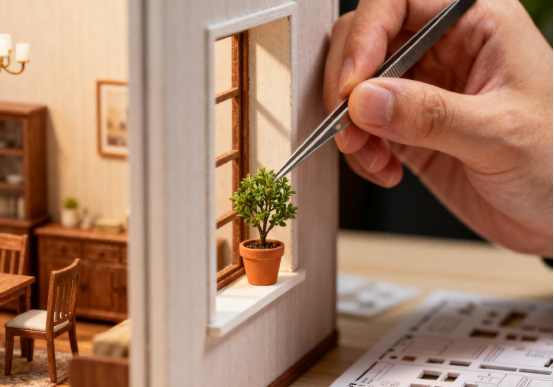
If you’re looking to mix and match scales, the easiest way to do this is to use small accessories as decorative accents. For example, adding a few small 1:24 scale plants or books to a 1:12 scale house won’t disrupt the overall effect; instead, it’ll add detail and interest. With clever placement, these small items can become the focal point of the room, adding a touch of life to the space.
3.4 Creating Fantasy or Unrealistic Scenes
If you’re open to experimenting with a more whimsical style, you can create a surreal or fantastical miniature world by mixing accessories at different scales. For example, you could mix 1:12 scale furniture with smaller 1:48 scale accessories to create a dreamlike scene. This design creates a strong visual impact and showcases the creator’s unique artistic style.
4. Conclusion: Creativity has no boundaries, and mixing proportions is feasible
In general, can you mix and match Kit Miniature House parts of varying scale? The answer is yes, but the key lies in how you utilize these varying proportions. If you’re striving for perfect realism and detail, maintaining consistent proportions is the safest bet. However, if you’re looking to push the boundaries of tradition with creativity, mixing and matching proportions is not only feasible but can even create unexpected visual effects.
Most importantly, creating a Kit Miniature House is a process full of individuality and freedom. Breaking the constraints of proportion and showcasing your unique style is the key to making your work stand out. With proper use, even accessories of varying proportions can become highlights in your work, adding infinite charm to your creation.