Kit Miniature House Proportions Revealed: How to Choose the Right Size
Whether you’re a beginner at Kit Miniature House or an experienced hobbyist, understanding different scales is always an important topic. In this world of model puzzles , scale not only affects the details and spatial perception of the model, but also determines the complexity of the build and the manual skills required.
What is a scale?
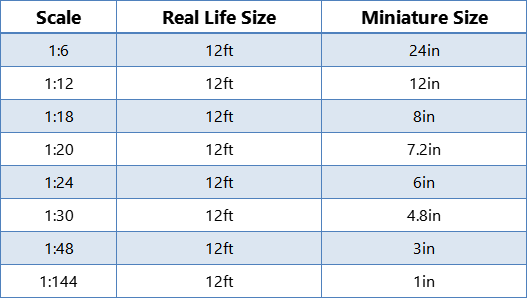
a kit’s miniature house describes the size relationship between the real object and its model. Generally, it consists of two numbers, often separated by a colon or dash (for example, 1:1 or 1-1). The first number represents the size of the real object, while the second number represents the reduced size of the real object. For example, a scale of 1:16 means that 16 inches in real life is equivalent to 1 inch in the kit’s miniature house . This means that the larger the second number, the smaller the reduced house . Understanding this is crucial for choosing the right model for you.
Common Kit Miniature House Proportions
There are many different scales on the market , each with its own unique characteristics. Choosing the right scale can impact your building experience, display quality, and even the space required. Here are some common scales and their characteristics.
1:6 scale – toy scale or fashion doll scale
1:6 scale is the largest of all scales and is commonly used for fashion dolls and collectible figurines, such as Barbie dolls and action figures. This scale is characterized by 6 inches in real life corresponding to 1 inch in Kit Miniature House . Due to its large scale, these figurines are often found in children’s toys or among toy enthusiasts, allowing for easy crafting and play.
Suitable for: This scale model is suitable for beginners, especially if you want to make a larger, more manageable house. It is worth noting that due to its large size, you need to consider the space when purchasing and storing it.
1:12 scale – one inch scale
1:12 scale (also known as one-inch scale) is one of the most classic and popular scales today . Beginning with Queen Mary’s Dollhouse in 1924, the 1:12 scale has become the standard for Kit Miniature Houses . The 1 foot to 1 inch ratio makes conversions intuitive and simple.
Applicable scenarios: 1:12 scale house models are widely used in various miniature buildings and furniture designs, and are particularly suitable for those who want to create complex and exquisite scenes. Due to its moderate size, it can show details without taking up too much space.
1:16 scale – ¾ scale
The 1:16 scale was very popular from the 1930s to the 1950s, and it strikes a good balance between detail and complexity. One inch in the Kit Miniature House is equivalent to 16 inches in real life, meaning 3/4 inch per foot.
Best for: This scale is ideal for those who want to create a slightly smaller yet detailed scene, often suitable for showcasing classic home environments, street scenes, or vintage-style models.
1:18 Scale – Lundby Scale
1:18 scale is sometimes called Lundby scale, after the Swedish company Lundby. In this scale, every inch of model size represents 18 inches of actual size. While slightly smaller than 1:12 scale, it still maintains a relatively high level of detail.
Suitable for: If you prefer modern puzzle models , the 1:18 scale is an ideal choice. Many beautifully designed modern kit miniature houses , such as the Mini Town Light and Shadow Building Block 3D Puzzle House , use this scale.
1:20 scale – custom scale
To meet market demand, we offer custom-scaled Miniature House Kits , with the 1:20 scale being particularly popular. At this scale, every 20 inches of real-world objects occupy only 1 inch in the miniature world. This compact size and ease of use make it a popular choice for many beginners.
Suitable for: If you want a compact and easy-to-operate model without sacrificing rich details, the 1:20 scale would be a good choice.
1:24 scale – half scale model
1:24 scale models are a smaller scale that has become increasingly popular among model enthusiasts in recent years. A 1-foot object in real life is only half an inch in the Kit Miniature House .
Applicable scenarios: Due to its small footprint, this scale is particularly suitable for displaying the Countryside Cafe – DIY Attic Villa 3D Puzzle Mini Hand-Assembled House . This makes the 1:24 scale an ideal choice for city models or block designs.
1:30 scale – custom scale
For hobbyists with limited space , the 1:30 scale is a great option. At this scale, a 30-inch object in real life is only 1-inch in size. Despite their small size, the models still retain exquisite detail.
Suitable for: The 1:30 scale is particularly suitable for those who are short on space but still want to experience the finest craftsmanship. For example, the Flower Fairy Diary – Healing Mini Bookshelf is a classic work of this scale.
1:48 scale – quarter scale model
1:48 scale models are much smaller than other scale models. Every 1 foot of the actual object is represented by only a quarter of an inch, which makes them much more difficult to produce.
Suitable for: This Kit Miniature House is suitable for experienced miniature builders, especially collectors who pursue precision craftsmanship and extreme details. Despite its high difficulty, its miniature scale and exquisiteness have won it many loyal fans.
1:144 Scale – Kit Miniature House
The 1:144 scale is the “extreme miniaturization” of Kit Miniature Houses and is usually used to display very detailed miniature landscapes and buildings. Although models of this scale are very small and have extremely fine details, they are relatively expensive due to the high production process requirements.
Suitable for: This scale is suitable for those who focus on creating the ultimate miniature landscape. Due to its tiny size, operation and preservation require great skills.
How to choose the right ratio?
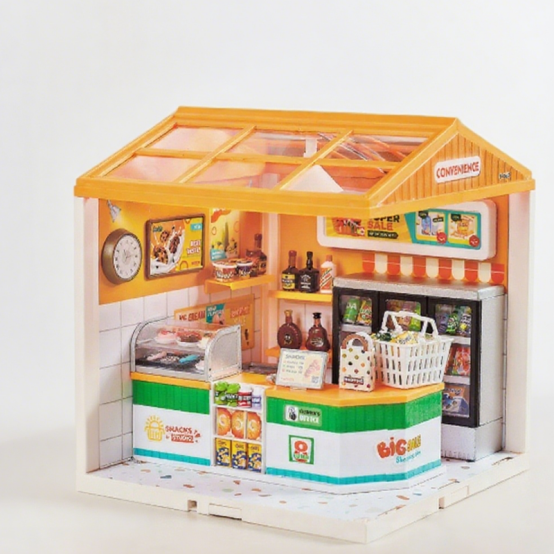
Choosing the right scale depends not only on your need for detail and space, but also closely on your personal skills, budget, and display objectives. If you’re looking for extreme detail and have ample space for display, 1:12 and 1:6 scales are good choices. If space is limited but you still want to experience the joy of building a Kit Miniature House , 1:24 or 1:30 scales may be more suitable.
In short, each proportion has its own unique charm. Choosing the right proportion can not only enhance the fun of building, but also make your work more personal and stylish.
