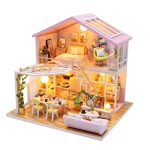
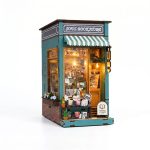
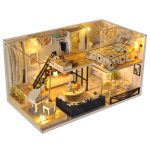
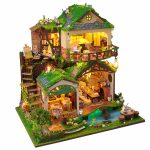
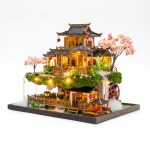



The boundaries of toys can actually be more interesting
If you are like me and have a special liking for Lego building and mini house models, then you may have also thought about this question:
Is it possible to let the Lego figures really “live” in a mini house?
It’s a wonderful feeling—the Kit Miniature House in your hand is no longer just a decoration but a “small world with people living in it.”
It has details, stories, and even a touch of warmth.
When “LEGO-compatible play” meets “mini-house crafting,” it’s more than just model building; it’s a crossover.
You can enjoy the freedom of LEGO construction while experiencing the captivating detail of a miniature house.
In this article, I’d like to show you how to combine these two play styles:
from why it’s worth trying and what materials you need to how to build it yourself and take beautiful photos of the finished product.
1. Why should we let Lego figures move into the Kit Miniature House?
1. The exquisiteness of handmade crafts + the fun of Lego
Lego gives people the joy of “creation,” while miniature house models give people the “beauty of completion.”
When you combine the two, you actually turn “toys” into an artistic experience.
The Miniature House Kit is essentially a miniature decoration, beautiful on a desk or bookshelf.
But when you place a LEGO figure inside, it comes alive.
The figure can sit on the sofa, gaze at the window, or cook in the kitchen—
Suddenly, the static model becomes a small world.
2. A new and creative way to play
While traditional LEGO sets tend to be more architectural or mechanical, “LEGO-compatible play” focuses more on storytelling and a sense of life.
You’re not “building a house” but “bringing characters into life.”
A player shared on Reddit: “I like to randomly put the little people into the model and let them act out their own little stories.”
Sounds fun, right?
The satisfaction of “I created a miniature world” is something that ordinary building can’t bring.
3. Surprises from small details
You meticulously decorate your Kit Miniature House: miniature books on the table, flowers by the window, and a small lamp on.
Then a Lego figure stands there, about to push the door open.
At that moment, this creation becomes more than just beautiful; it tells a story.
Before you begin: Preparation checklist
1. A Kit Miniature House
Choose a model that you like and has a reasonable structure. It is best to have a slightly wider space so that the figurines can move more naturally.
When choosing, pay attention to the following:
It is best to have layers inside so that furniture can be placed.
The floor and walls must be stable.
The style (modern, European, vintage) should best match your little one.
2. Lego figures
This is the star of the show.
It doesn’t matter if it’s a classic, custom-made, or brand-compatible.
I recommend adding accessories like a small book, a lamp, or a pet—they can make the scene more vivid.
3. Furniture and decoration
You can choose ready-made miniature furniture or build some yourself using Legos.
The key is to create a cohesive style and avoid overcrowding. Leaving some “room for movement” creates a more natural look.
4. Tools and lighting (optional)
Glue, double-sided tape, scissors, and a knife are essential.
If you want to create a night scene, you can add a miniature LED light.
When the light is on, the image of the little figure sitting by the window is truly soothing.
3. Hands-on creation: let the little man “move in” step by step
Step 1: Plan the scene
Start by sketching out a simple plan—deciding which areas will be the living room, bedroom, and study.
For example, “My little one will wake up on the second floor, go downstairs for breakfast, and gaze at the stars by the window at night.”
Planning activity areas ahead of time can help avoid the awkward situation of “running out of space” later on.
Step 2: Reconstruction
The doorway, floor height, and window sill position of the Kit Miniature House may require minor adjustments.
Adjust the door width and platform height to allow the miniature figures to “enter the house” naturally.
Remember to ensure the structure is stable, as it will accommodate characters and furniture.
Step 3: Set the scene
This step is the most fun.
You can mix and match LEGO furniture with miniature house decor—
For example, use LEGO bricks to build a small bookshelf and add a miniature house table lamp.
Then place the miniature figures, one sitting and reading and one busy in the kitchen.
Don’t be too neat; leave some “messy feeling of life,” it will be more real.
Step 4: Take photos and display
Once everything is set up, take a few photos.
Try experimenting with angles, like shooting from a window or using a small light.
You can even make up a story like, “On a weekend afternoon, a little man cleans the house”—it
It’s a bit playful and heartwarming.
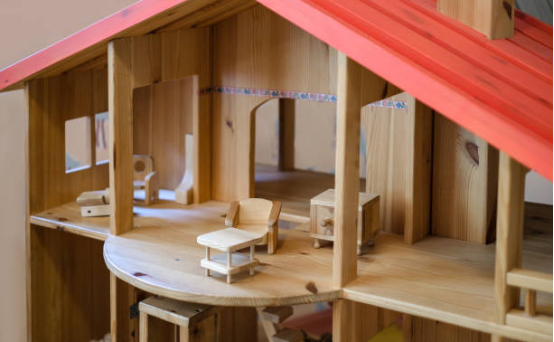
IV. Precautions and Tips
The proportions should be reasonable
. Lego figures are about 4 cm tall.
Doorways, tabletops, and stairs should all be designed around this size.
Anything too short or too tall will look awkward.
Keep the structure stable.
Some miniature houses are made of wood, plastic, or cardboard.
If you frequently reposition your miniature figures, it’s recommended to reinforce the floor and furniture.
The scene should be balanced
so that the Lego figures don’t dominate, and the house shouldn’t be too complicated.
Ideally,
The house provides the space, and the figures bring the story.
Lighting and atmosphere
Warm light is the best for shooting mini scenes.
Paired with a soft background (such as starry sky stickers or garden cardboard), the effect will be very good.
5. Conclusion: A Little World of Your Own
“LEGO-compatible play” is more than just a way to play; it’s more like a form of creative expression.
What you build with Kit Miniature House isn’t just a house; it’s a living, breathing universe.
There are your little people, your furniture, and your stories.
Maybe it’s a warm family of three, or a small adventure team—
No matter what, it’s full of personality.
If you enjoy building, setting up sets, and creating, then give it a try.
When you build your own “Lego Mini House” with your own hands,
you’ll discover
that the boundaries of toys can be so heartwarming.