



Miniature Zen Garden Kits: How to Choose the Right One for Your Shelf, Desk, or Gift
What Counts as a Miniature Zen Garden Kit
When you search for miniature zen garden kits, three very different products share one keyword. Before you compare prices or read reviews, figure out which format you actually want. The answer changes everything — size, build time, where it lives in your home.
Desktop sand gardens. A tray, fine sand, a few stones, a miniature rake. The appeal is tactile — the weight of the rake in your hand, the sound it makes pulling through sand, the parallel lines left behind. You rearrange. You smooth it out. You start again. These are not really “kits” in the assembly sense. They arrive mostly finished. The building is the raking.
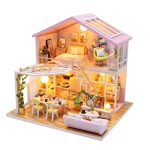
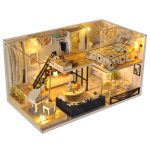
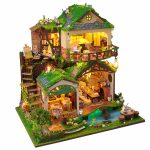
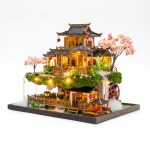
Diorama garden scenes. A constructed three-dimensional model of a garden, courtyard, or greenhouse. Laser-cut wood, miniature plants, sometimes LED lighting. You build it over several hours, piece by piece. The finished thing sits on a shelf or desk and you look into it — it’s a display object, not an interactive one.
Book Nook garden inserts. A narrow scene designed to fit between books on a shelf. From the side, it creates the illusion that there’s a garden path, a greenhouse, or a courtyard extending behind your books. The constraint of shelf width — typically 4 to 5 inches — means every millimeter of perceived depth is designed, not found. Garden-themed inserts are one of the fastest-growing subcategories in miniature kits right now. If the garden aesthetic on your bookshelf is what drew you here, miniature greenhouse and floral kits are worth exploring as a starting point.
The keyword “miniature zen garden kits” pulls all three formats into one search. Decide which one matches your space and your intention before you start comparing individual products.
Five Things to Check Before You Buy
Once you know which format you’re after, these are the criteria that actually matter.
1. Size and placement
Desktop sand gardens typically run 8–12 inches wide. They need a flat, stable surface — a desk, a coffee table, a windowsill. Book Nook inserts are about 4 inches wide and 8–10 inches tall, designed to slot between books. Diorama kits vary more, but most are deep enough that you need shelf depth of at least 6 inches. Measure your space before you order. Not after.
2. Material
Most quality miniature kits use laser-cut basswood plywood. Basswood is light, fine-grained, and cuts cleanly to ±0.1mm precision. That precision matters: when tolerances are tight, joints fit together instead of requiring you to force or sand them. Budget kits often substitute MDF (medium-density fiberboard), which is heavier and produces less detail at the edges. The difference is visible in the finished piece and felt during assembly.
3. Piece count
This is the most honest signal of complexity. A kit with 50–100 pieces will take a few hours. A kit with 200–350 pieces is a full afternoon — or two. More pieces means more detail, but also more decisions, more tiny joints, more time with a craft knife in your hand. If you’re new to Book Nook miniature kits and diorama building, starting in the 150–250 range gives you enough challenge to feel invested without burning out around step 47.
4. LED lighting
A warm-white LED string changes how the finished piece reads on a shelf — especially in the evening, with other lights low. Every Nookcraft kit includes an LED string. Not every brand does. Some sell lighting as a separate add-on. Check the product listing before you assume.
5. Instruction language and format
In our experience, the most common sticking point for builders isn’t the complexity of a step — it’s not understanding what the step is asking. We once let three people who had never touched a miniature kit build the same model and recorded where they got stuck for more than ten minutes. All three hit the same two points: roof tile layering and threading LED copper wire through anchor holes. The instructions weren’t wrong. They were written for someone who already knew what the result should look like. Full-color English photo instructions with callout arrows solve this. If a listing doesn’t show you what the instructions look like, that’s a gap worth questioning.
Garden Scenes Between Books — When a Shelf Insert Is the Better Fit
Book Nook kits are harder to design than full house kits of the same size. Not because the pieces are more complex, but because you’re compressing three-dimensional depth into a space defined by how far apart someone’s books happen to be. Every measurement is a constraint.
Garden-themed Book Nooks work particularly well in this format. Stone paths, arched trellises, layered foliage — these are elements that create natural depth cues. Your eye follows the path inward. The arch frames something behind it. The plants get smaller toward the back. Forced perspective does the heavy lifting, and garden scenes are one of the few themes where the illusion holds almost all the way to the back wall.
If what you want is a garden you can see — not rake, not rearrange, but look into — the Book Nook format gives you that on a shelf that’s already in your house. Browse all miniature house kits to compare garden-themed Book Nooks alongside other scene types like workshops, libraries, and street corners.
What Real Assembly Looks Like — Time, Difficulty, and Session Planning
Nookcraft kits are rated Intermediate (about 4–7 hours) or Advanced (about 8–15 hours). We don’t label anything “beginner.” Every kit requires some patience, some precision, and a willingness to follow steps that might not make sense until you see what they’re building toward.
Real assembly time is almost always longer than the number on the box. We track this. The declared time is usually the fastest a competent builder could go if nothing went wrong and nothing needed rethinking. We add 30–40% to that number and tell buyers to plan for two sessions, not one.
The first session is foundation — walls, base, main structure. It’s the part where you’re reading every step twice and thinking, “Is this right?” The second session is where the kit starts looking like something. Details go in. The LED wire threads through. The tiny plants layer up. The second session is almost always better — the glue from session one has set, you’re not rushing, and you can actually enjoy the last 20 steps.
Common sticking points, based on what we’ve seen in testing and buyer feedback: fine LED wiring — glue near wire ends causes intermittent failure, which is why our instructions include a warning box at that specific step — layering small botanical elements in the right order, and aligning pieces that must meet at exact angles.
You will need: super glue (cyanoacrylate — not included in kits), and a CR2032 button battery for the LED (also not included). A small craft knife and tweezers help with positioning, but aren’t required. That’s the full supply list.
If something arrives missing or damaged, we replace the part free of charge. 30-day returns on all orders.
If You’re Giving This as a Gift
A miniature garden kit is a specific kind of gift. It’s not something you hand over ready to use — it’s a project. That’s the point. But it means the recipient needs the right kit for their situation.
Match difficulty to experience. An Intermediate kit (4–7 hours, 150–250 pieces) is right for someone who’s done one or two craft projects, or who builds LEGO sets and wants something different. An Advanced kit (8–15 hours, 300+ pieces) is for someone who already builds miniatures or models and wants the next level of detail.
Include a note. Write on the card: “This is a two-afternoon project.” It removes the pressure to finish in one sitting. The second session is where the real enjoyment lives — most builders tell us session two is where they stop reading ahead and start trusting the process.
Add two things the kit won’t include: a small tube of super glue and a CR2032 battery. Saves the recipient a trip to the store. If they plan to display the finished piece on a shelf — and most people do — a dust cover or display case is worth considering as an add-on. For more on choosing kits as gifts for adults, see adult miniature craft kits for gifting.
Frequently Asked Questions
What’s included in a miniature zen garden kit?
A typical kit contains laser-cut wooden parts, miniature accessories (stones, plants, and sand for desktop types), an LED string or light unit, and printed step-by-step instructions. What’s usually not included: super glue, batteries (CR2032 for most Nookcraft kits), and a display case or dust cover. Check the product listing for a full contents list before ordering.
How long does it take to assemble a miniature zen garden kit?
Intermediate kits take approximately 4–7 hours. Advanced kits take 8–15 hours. In our experience, these numbers are optimistic — add 30–40% for a realistic estimate. We recommend splitting the build across two sessions: one for the foundation structure, one for details and finishing.
Can I display a miniature garden kit on a bookshelf?
Book Nook inserts are specifically designed for this — they fit between books and create a garden scene that extends into the shelf. Desktop sand gardens need a flat, open surface. Diorama kits fit on shelves but require more depth, typically 6 inches or more. Measure your shelf before ordering.
What’s the difference between a zen garden kit and a fairy garden kit?
Zen garden kits emphasize minimalism — sand, stones, negative space, and clean lines. Fairy garden kits lean toward whimsy: tiny houses, fantasy elements, and denser scene-building. Nature-themed Book Nooks overlap with both — they use garden aesthetics (plants, paths, arches) without the explicit “zen” or “fairy” styling.
Do I need any tools or supplies not in the kit?
Yes. You’ll need super glue (cyanoacrylate) for wood joints, and a CR2032 button battery to power the LED. A small craft knife helps with trimming, and tweezers are useful for positioning small parts — but neither is strictly required. No specialty tools needed.
If a garden scene on your bookshelf sounds like the right fit, see how Nookcraft’s nature-themed Book Nooks are designed — laser-cut basswood, full-color English instructions, and an LED string in every kit. Browse miniature greenhouse and floral kits →