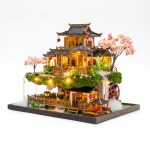



Miniature Coffee Shop Kit: How to Choose Your First (or Next) Scene Build
You are standing in front of a shelf gap, measuring with your fingers. Four inches, maybe five. You are thinking about a counter with a tiny espresso machine, a pastry case, two small chairs by a window that does not exist yet. A miniature coffee shop kit is one of the most popular scene types in this category — and one of the easiest to choose wrong if you do not know what you are looking at. This guide walks through the four things I check before recommending a coffee shop kit to anyone, then breaks down the three main types you will find.
What Makes a Coffee Shop Scene Work as a Miniature Kit?
Most miniature scene kits are about building a room. A coffee shop kit is about building an atmosphere. The difference matters in design: you are not just stacking walls and a roof. You are compressing a counter, seating, a menu board, a pastry display, and maybe a hanging pendant light into a space that might be six inches deep.
The design challenge is depth perception. When you look into finished coffee shop scene from the side, your eye needs to believe there is a counter in front and a back wall behind it. In a full-size house kit, you have real depth to work with. In a shelf insert or a compact diorama, every millimeter of perceived depth is designed, not found. I have tested kits where the counter and back wall are three inches apart, and the scene still reads as a room — that is careful layering, not luck.
Common elements across most miniature coffee shop kits: an espresso machine at roughly 1:12 scale, a glass-front pastry display, one or two small tables with chairs, a chalkboard menu, and overhead lighting. The quality of these elements varies a lot. Some kits give you a molded plastic espresso machine; others give you four laser-cut basswood pieces that slot together and actually look like an espresso machine at the end. The second kind takes longer. The second kind is the one I keep on my shelf.
If you are interested in more advanced scene-building techniques — layered backdrops, forced perspective, custom depth — our miniature diorama kit guide covers the principles that apply to any scene type, including coffee shops.
How to Choose: The Four Practical Filters
When someone asks me which DIY miniature coffee shop kit to start with, I do not ask about their favorite color scheme. I ask four things.
Filter 1: Difficulty and Assembly Time
Intermediate kits run about 4–7 hours. Advanced kits run 8–15 hours. These are realistic numbers — the times printed on most kit boxes are what a fast, experienced builder could do if nothing went wrong. Based on the kits we have tested and the builders we have heard from, I add 30–40% to any declared time and tell people to plan for two sessions, not one. The second session is almost always better: the glue has set on the first batch of joints, you are not rushing, and you can actually enjoy the detail work in the later steps.
What makes a coffee shop kit land in the Advanced range is usually the small repetitive parts. Tiled floors made of 40-something individual pieces. Chair spindles the size of a matchstick. A pastry case with six tiny croissants. None of these are difficult in concept. They require patience and steady hands, not skill. Know that going in.
Filter 2: Scale and Shelf Fit
1:12 scale is the most common — one inch equals one real foot. A miniature coffee shop at 1:12 scale usually sits about 7–10 inches wide and 6–8 inches deep. Measure your shelf gap before you buy. If you have a specific 4–6 inch space between books and you want the scene to sit inside that gap, you are looking for a Book Nook insert, not a standalone diorama. Some coffee shop kits are designed as Book Nooks from the start. Others are standalone scenes that happen to be coffee shops. The distinction matters for where it goes on your shelf.
Filter 3: Piece Count and Material
Piece count is the most reliable indicator of interior detail. A kit with 80–120 pieces will give you walls, a counter, a few chairs, and basic props. A kit with 150–300+ pieces will include things like individual coffee cups, a cash register, wall art, a bookshelf in the corner, tiny plant pots. More pieces means more time, but also more of the small details that make a coffee shop feel like a place rather than a box with furniture.
Material matters too. Laser-cut basswood is standard in kits we consider worth building — it cuts clean at ±0.1mm precision, takes paint, and produces a warm natural finish. MDF board is cheaper, heavier, and does not have the same grain. If the product listing does not specify wood type, assume MDF. Nothing wrong with MDF if you are testing whether you like the hobby. But if you already know you will finish it, basswood is the material to look for.
Filter 4: Light Source
Every Nookcraft kit includes an LED string with warm-white wire and battery compartment. Not every brand does this. Check before you buy. A miniature coffee shop scene without lighting is a model. With lighting — a warm glow from a pendant lamp above the counter, or a string along the back wall — it becomes a place you want to look into. One thing I learned the hard way: keep glue away from the LED wire ends during assembly. Contact between cyanoacrylate and copper wire causes intermittent failure. We added a warning box at that step after one buyer emailed us about it. Her LED had stopped working on day three. The fix was simple once we knew the cause, but she should not have had to figure it out alone.
Three Common Coffee Shop Kit Types (And Who They’re For)
Not all miniature shop kits follow the same design philosophy. Here is how I sort them.
Type A: The Full-Counter Diorama
Deep scene, many small props — pastries on trays, a working (LED) menu sign, bottles behind the counter, maybe a cat sleeping on a chair. This is usually Advanced difficulty, 8–15 hours. The piece count runs 200+. Best for builders who want to spend a weekend inside the story of a space. You are not just assembling; you are furnishing a café that someone might walk into. If you have done one or two kits before and you want the next thing, this is the direction.
Type B: The Cozy Corner Book Nook
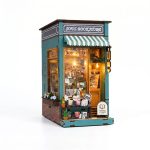
Designed to fit between books on a shelf. Often has a window or doorway at the back that creates the illusion of depth — you look in and see a counter, a few chairs, a back wall with a painting. Intermediate difficulty, 4–7 hours. Piece count around 100–180. This is the one for shelf aesthetics. If you have been standing in front of that gap on your bookshelf thinking about what goes there, this is the type. The finished piece sits flush between your books and lights up when you want it to.
Type C: The Modular Shop Front
Simpler facade with fewer interior pieces. Sometimes the focus is on the storefront exterior — an awning, a window display, a door — rather than a full interior build. Piece count under 120, assembly time around 3–5 hours. This can be a stepping stone if you have never built a miniature kit, or a quicker build if you want a result in one session. Check the piece count carefully: some modular kits look detailed in photos but contain fewer pieces than you expect.
Related Scenes: From Café to Greenhouse
If the warmth of a coffee shop interior appeals to you but you want a different subject — something with more plants, more glass, more green — a miniature greenhouse or floral kit might be the better fit. The build experience is different: floral kits involve more assembly of individual flowers, leaves, and plant pots. That kind of repetitive, small-scale work is its own kind of focus. Some builders prefer it. Some find it tedious. But the core skill — following layered instructions, working with laser-cut wood pieces at small scale — transfers directly between a café scene and a greenhouse scene.
The other category worth mentioning: a tailor shop miniature kit or a flower shop miniature kit occupies the same design space as a coffee shop — a small, detailed interior that tells a story about what happens inside. If you have built a coffee shop and you want the next shelf gap to have a different world in it, these are the natural neighbors.
Frequently Asked Questions
How long does a typical miniature coffee shop kit take to build?
Intermediate kits: 4–7 hours. Advanced kits: 8–15 hours. These are realistic estimates — we add 30–40% to the time printed on the box. Most builders we have heard from find it best split across two sessions. The second session is usually more enjoyable because the first round of glue has cured and you are not rushing.
Do I need to buy glue or batteries separately?
Yes. Super glue (cyanoacrylate) is usually not included in kits — you need to purchase it separately. Batteries are also not included. Most Book Nook and compact kits use a CR2032 button cell. Check the product listing for battery type before your kit arrives so you are not waiting to finish.
What is the difference between a coffee shop kit and a Book Nook?
A Book Nook is a type of miniature kit specifically shaped to fit between books on a shelf — viewed from the side, it creates the illusion of a world behind your bookcase. Some coffee shop kits are designed as Book Nooks. Others are standalone dioramas meant to sit on a shelf or table. The coffee shop is the scene; the Book Nook is the format. A kit can be both.
What if a piece is missing or damaged?
Nookcraft offers 30-day returns and free replacement parts for any missing or damaged pieces. Email support with your order number and a photo of the issue. We ship replacements without requiring you to return the original kit.
Ready to find the right coffee shop scene for your shelf? Browse our coffee shop and café scene kits to compare difficulty levels, piece counts, and lighting — and find one that fits the gap you have been measuring.