




Most people approach choosing a book nook kit with the wrong question. They ask “which one looks the best?” The one worth asking is: “which one will still look right on my shelf six months from now, and which one will I actually finish?”
This guide answers both. Every kit listed here is from Nookcraft’s current lineup — chosen for visual distinctiveness on a shelf, honest build time, and the thing that actually separates a book nook from everything else in this category: the depth effect that makes it feel like a window, not a decoration.

What Makes a Book Nook Different from a Regular Miniature House
This is the part most buying guides skip, and it’s worth understanding before you choose a miniature book nook kit.
A standard miniature house kit has a clear structural logic: floor, then walls, then roof. There’s an obvious front and an obvious back. The assembly sequence follows gravity.
A book nook works differently. It inserts into a bookshelf gap and must read as a 3D scene when viewed from a single fixed angle — straight on, at roughly eye level. That means it needs a true foreground, a middle layer, and a perceived background, all compressed into a space that’s typically 5 inches deep or less.
When we tested the first prototype of our earliest book nook, the scene felt like looking at a painting. Flat. The depth was there geometrically but not visually. Adding a front-facing element that extended slightly toward the viewer — a window ledge, a cobblestone step, a protruding eave — changed the entire read. That one structural detail is what shifts a book nook from “panel” to “portal.” Every kit in this list has it. It’s one of the strict visual checks we run before a scene makes it to production.
It’s also why a book nook is mechanically harder to design than a comparably-sized complete house kit — and why the instruction sequence matters more. You’re building a scene for one viewing angle, under LED lighting, against the visual competition of actual books. Every element has to earn its position.
Before You Choose: Three Things That Actually Matter
1. Shelf fit. All Nookcraft bookshelf miniature kits assemble to roughly 8.3″ deep × 9.2″ tall × 5.0″ wide. Before ordering, measure the gap between your books — width and height. Most standard shelving accommodates these dimensions comfortably; deep-set shelves with fixed dividers occasionally don’t. Details are on each product page.
2. Scene aesthetic. You’ll look at this piece every day. Choose a scene that matches the shelf it’s going on, not just the one that photographs well in isolation. A dark gothic study reads very differently next to paperback thrillers than it does next to leather-bound classics. We’ve organized the picks by aesthetic below so you can find your visual register first.
3. Build time. Every kit in this guide is rated Intermediate, requiring approximately 5–8 hours of hands-on time. The honest recommendation for a first diy miniature book nook kit: split it across two sessions. The LED wiring needs to be routed before certain wall panels close, and that’s easier to pace when you’re not trying to finish in one sitting.
Scene Guide — Which Aesthetic Is Yours?
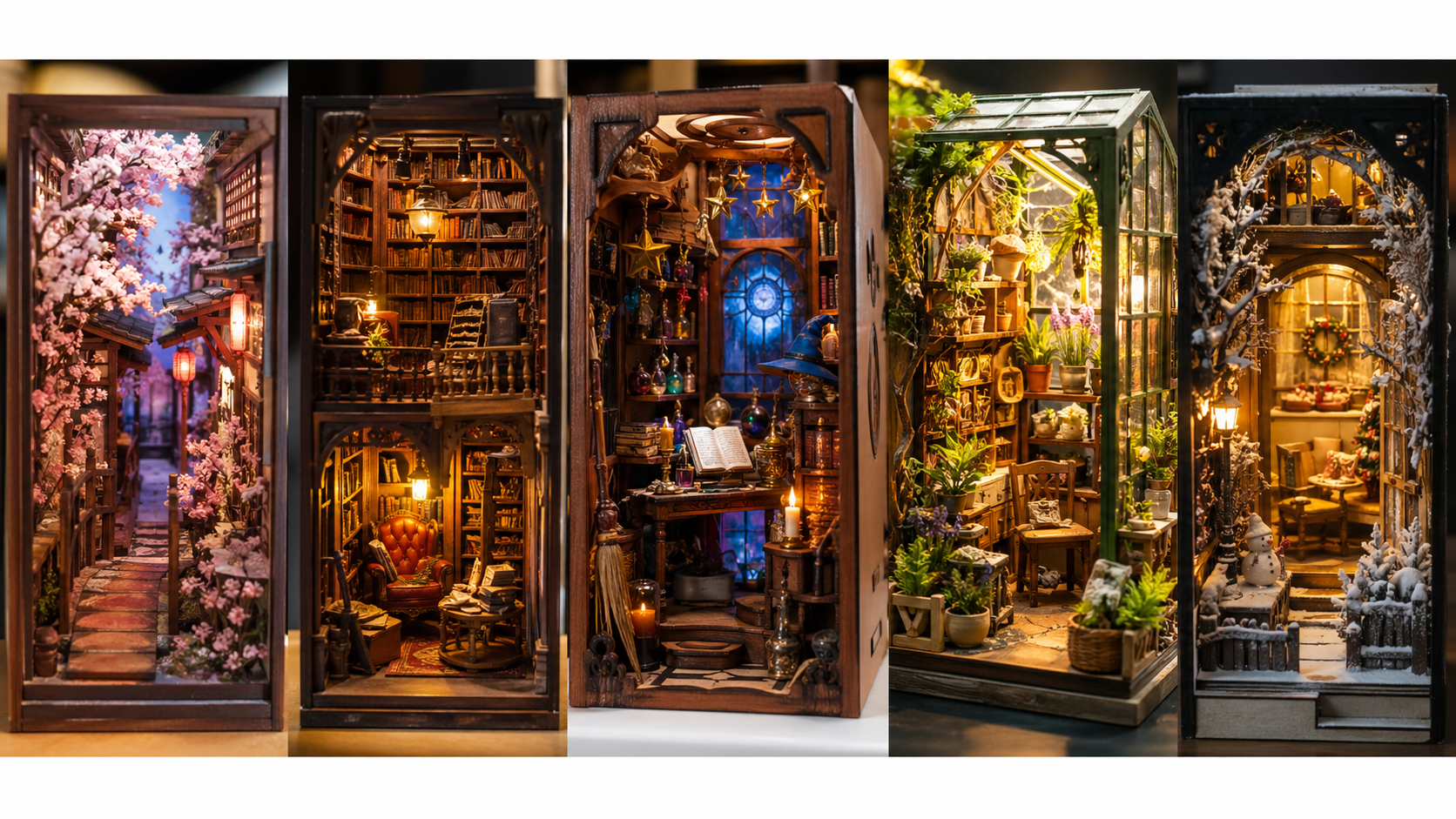
Not all book nooks read the same on a shelf. Here’s how the scenes in our lineup divide by visual register:
- Japanese / East Asian — Lantern light, natural wood textures, canal views, nighttime alley depth.
- Dark Academia / European Study — Warm candlelight tone, book spines, leather textures, scholarly density.
- Fantasy & Magic — Dragon scales, wizard archives, alchemy benches, glowing spell volumes.
- Botanical / Floral — Translucent acrylic glass panels, soft plant textures, greenhouse light quality.
- Seasonal / Festive — Winter market palette, warm shop window, amber light.
- 360° / Freestanding — Viewable from all four sides, not a shelf-insert format.
Best Book Nook Kits — Ranked by Scene
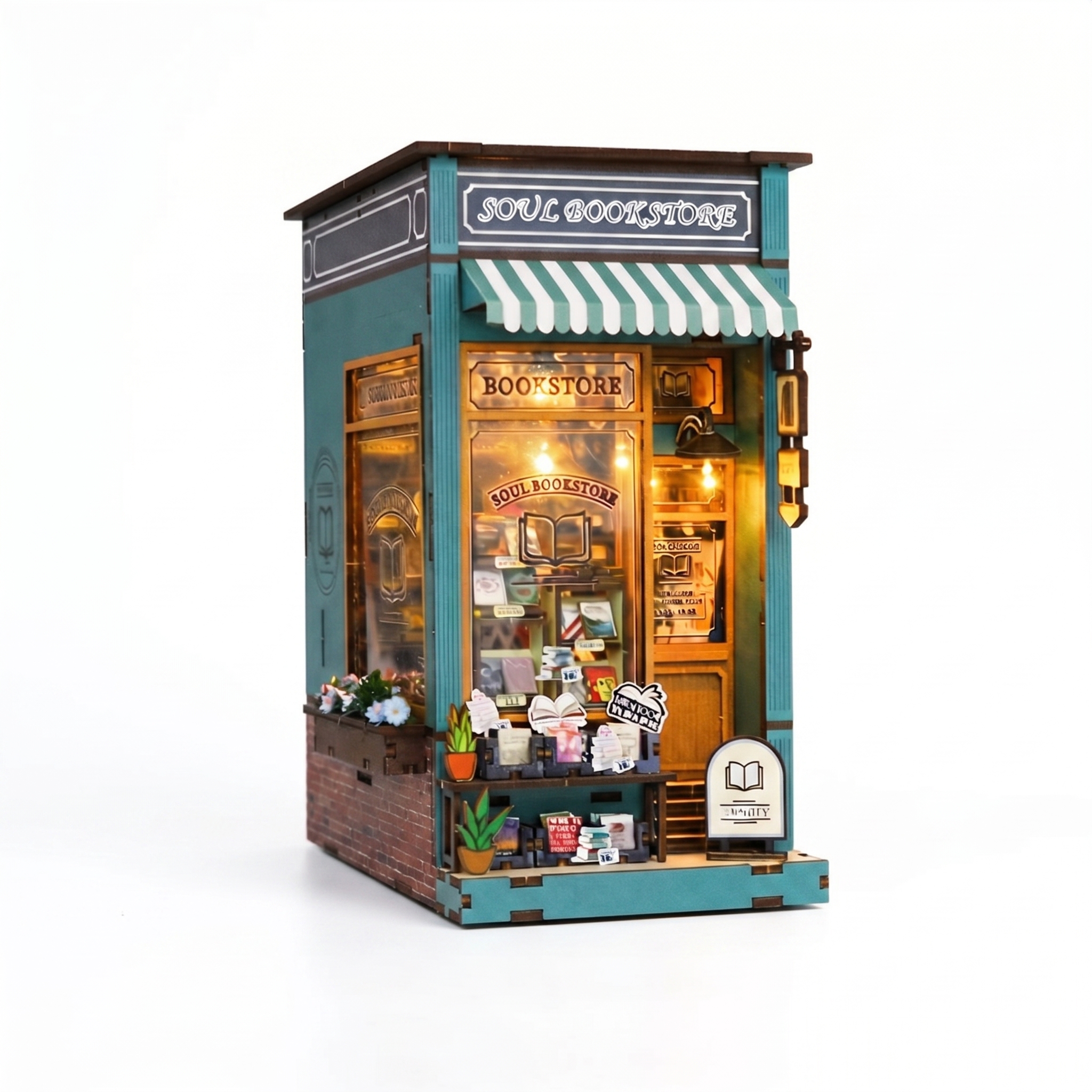
All kits below feature: Intermediate difficulty · 5–8 hours build time · LED included · full-color English photo instructions · ±0.1mm laser-cut basswood.
🌸 Japanese / East Asian Scenes
Cherry Blossom Book Nook | The Kyoto Canal — $35.99 8.3″ × 5.0″ × 9.2″ · Intermediate · 5–8 hrs A canal-side view in cherry blossom season, with layered foreground petals and warm LED lantern light filtering through the middle distance. The scene works because the canal creates natural horizontal depth — your eye is led inward, not stopped at the back wall. A forgiving build in terms of wire routing. View Cherry Blossom Book Nook →
Japanese Alley Book Nook | Midnight Cat Alley — $36.99 Intermediate · 5–8 hrs A nighttime alleyway scene with a cat detail in the foreground and lantern-lit depth. This is the scene that reads most dramatically under LED lighting with ambient room lights turned low. The narrow alley perspective provides strong visual depth without requiring complex interior furniture layering. View Japanese Alley Book Nook →
Oriental Bookstore Book Nook | The Bamboo Scholar — $36.99 Intermediate · 5–8 hrs A scholar’s bookshop with bamboo detailing and warm overhead light. For builders who want a literal miniature library kit — books visible inside the miniature itself. Pairs well on shelves with East Asian literature or art books. View Oriental Bookstore Book Nook →
📚 Dark Academia / European Study Scenes
French Vintage Study Book Nook | The Parisian Desk — $36.99 Intermediate · 5–8 hrs The most detail-dense build in the dark academia category. A Parisian writing desk with stacked paper components, a small window with curtain detail, and a warm desk-lamp LED effect. The paper components in this kit require a glue stick, not liquid adhesive — a step where following the exact instruction sequence pays off. View French Vintage Study Book Nook →
Cobblestone Alley Book Nook | The Midnight Corner — $35.99 8.3″ × 5.0″ × 9.2″ · Intermediate · 5–8 hrs A European street corner at night, cobblestone foreground, lantern at mid-frame. The street scene format gives this the clearest depth illusion of any kit in the lineup — the cobblestone texture carries the eye from front to back effortlessly. View Cobblestone Alley Book Nook →
Rare Book Room Book Nook | The Antiquarian’s Archive — $36.99 Intermediate · 5–8 hrs Floor-to-ceiling shelving, rare manuscript details, and the particular amber quality of old library light. For the builder who wants their book nook to look like an extension of a Victorian private collection. More interior detail means more precise paper and fabric component work. View Rare Book Room Book Nook →
🐉 Fantasy & Magic Scenes
Magic Library Book Nook | The Wizard’s Archive — $35.99 Intermediate · 5–8 hrs Floating books, spell-light detail, and archive shelves that extend into implied distance. The LED in this kit does significant visual work — the lighting is positioned to suggest spell-glow rather than simple room illumination. View Magic Library Book Nook →
Fantasy Dragon Book Nook | The Hidden Lair — $29.99 Intermediate · approx. 4–6 hrs The most accessible entry point in the book nook lineup. Lower piece count, shorter build time, and a dragon-cave scene that reads strongly with minimal interior layering. View Fantasy Dragon Book Nook →
Wizard Workshop Book Nook | The Alchemist’s Study — $32.99 Intermediate · 5–8 hrs Alchemy bench, potion bottles, component-dense worktable. The potion bottle elements are cast resin — handled slightly differently from the wood and paper components, which the full-color instructions cover step by step. View Wizard Workshop Book Nook →
🌿 Botanical Scene
Floral Greenhouse Book Nook | The Glass Conservatory — $34.99 Intermediate · 5–8 hrs Translucent panel construction with botanical interior detail. The only book nook in the lineup that uses transparent acrylic as a primary visual element. The light behavior through the glass panels makes this scene read distinctly differently from wood-heavy kits. View Floral Greenhouse Book Nook →
🎄 Seasonal Scene
Christmas Shop Book Nook | The Winter Melody — $37.99 Intermediate · 5–8 hrs A winter market shop interior with snow-dusted window detail. Designed to display year-round — the color palette skews amber and deep red rather than primary holiday colors, reading as “winter atmosphere” rather than strictly seasonal. View Christmas Shop Book Nook →
📐 360° Freestanding Format
360 Miniature Book Pavilion | The Four-Sided Archive — $40.99 Intermediate · 5–8 hrs Not a shelf-insert — this is a freestanding pavilion, viewable from all four sides. The build sequence differs from the standard book nook insert format, with four distinct façades constructed before the interior is detailed. View 360 Miniature Book Pavilion →
What to Expect During the Build (And What Nobody Tells You)
The instruction sequence in a book nook is more rigid than in a standard miniature house because you’re working toward a single fixed viewing angle. Steps that look optional — like installing a front-facing ledge detail before the side walls go in — are not optional. That ledge is what creates the foreground plane. Without it, the scene reads flat.
The LED routing step happens before you might expect it to. Most book nooks require the wire to be threaded through specific channels before certain panels are glued closed. Reading three steps ahead at any given point in the manual will keep you from finding this out after the fact.
The one-minute test applies here more than anywhere: when the last structural piece is fitted but before it’s glued, slide the scene between two books on your actual shelf, turn on the LED, and step back. That’s the only accurate preview of how it will read in its real context. Adjust what needs adjusting before the glue sets.
Book Nook Sizing — Will It Fit Your Shelf?
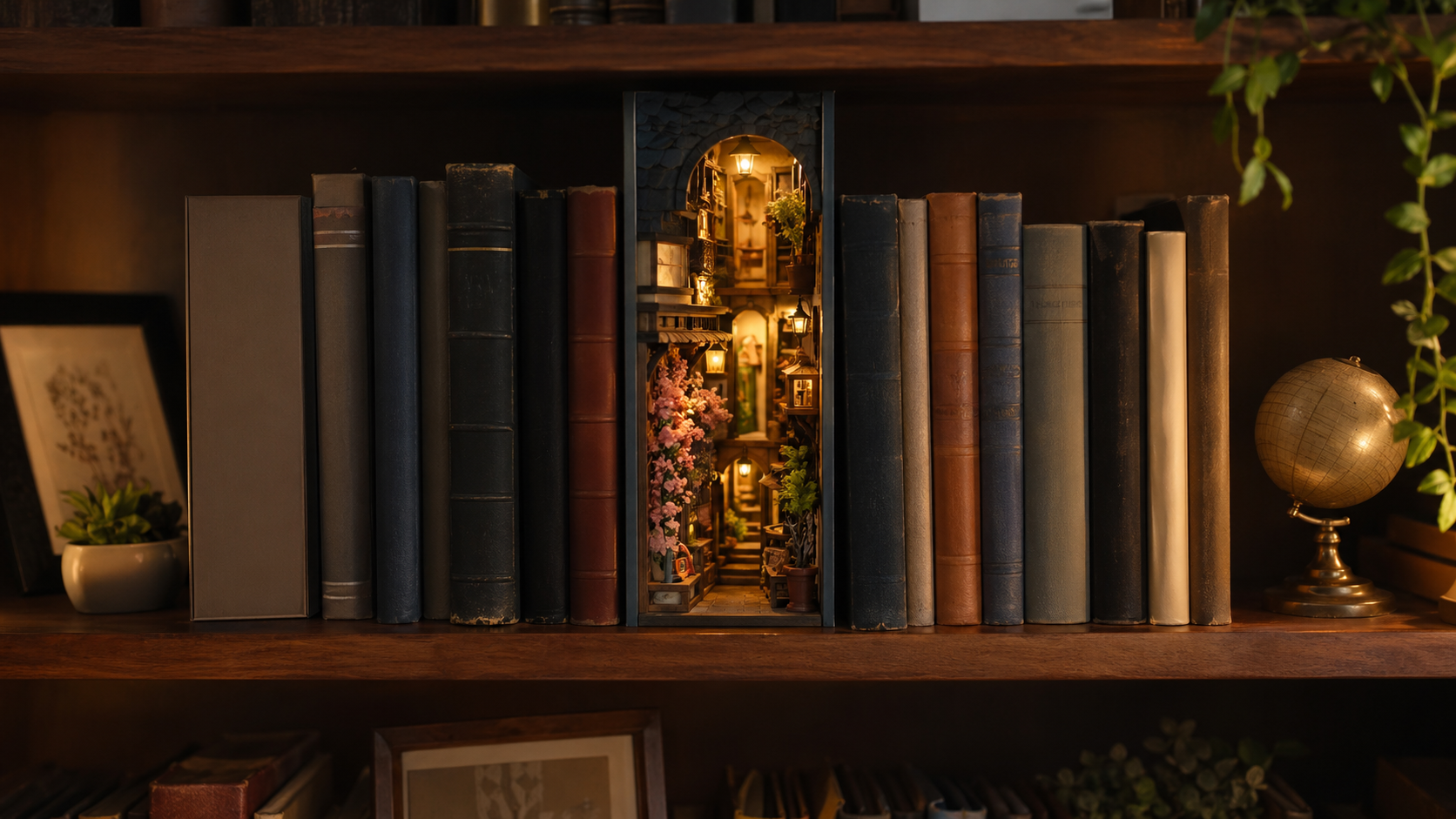
Most Nookcraft book nooks assemble to 8.3″ deep × 9.2″ tall × 5.0″ wide. This fits standard open shelving including IKEA BILLY and KALLAX units with shelf spacing of 10″ or more.
Before ordering, measure: the gap width between your books (you need at least 5.5″ to slide it in and out without forcing), the shelf height above the base (9.5″ minimum clearance), and the shelf depth (8.5″ minimum to sit flush).
If you have a specific shelf configuration you’re not sure about, contact us before ordering — we’ll confirm the fit before you commit.
Frequently Asked Questions (FAQs)
What is a miniature book nook kit?
A miniature book nook kit is a 3D diorama designed specifically to be inserted between books on a shelf. Unlike standard miniature houses, book nooks are built with forced perspective to create the illusion of a deep, extending world—like an alleyway or a hidden room—when viewed directly from the front.
Do DIY miniature book nook kits include LED lights?
Yes. All Nookcraft intermediate and advanced book nook kits include warm-white LED light strings and the necessary battery boxes. The lighting is crucial for the depth illusion. Note that due to shipping regulations, standard batteries (usually AAA or CR2032 button cells) are not included in the box and must be sourced locally.
How long does it take to build a bookshelf miniature kit?
An intermediate book nook kit takes roughly 5 to 8 hours of active, hands-on building time. This does not include the time spent waiting for glue to dry. For the best experience, we recommend splitting the build across two or three separate sessions.
Are book nook miniature kits suitable for beginners?
Are book nook miniature kits suitable for beginners? Yes, if you choose the right design. While rated as Intermediate due to LED wiring and paper components, scenes with strong geometric depth (like alleyways or canal scenes) require less tiny furniture assembly and are highly forgiving for first-time builders willing to follow the step-by-step English instructions.
Find Your Book Nook
Every book nook in this guide ships with full-color English photo instructions, LED lighting included, and 30-day returns. Missing pieces are replaced, no questions asked.
Browse the full Book Nook Kits collection →
Not sure if a book nook or a freestanding miniature house is the right direction? The Book Nook guide covers what to look for and how to choose by shelf type.
About this article Written by Ellie Nakamura, Founder of Nookcraft. Content is based on hands-on kit builds, instruction manual design experience, and build questions collected from our customers. Where conclusions are based on personal observation rather than third-party testing, this is noted in the text. Last reviewed: April 2026