


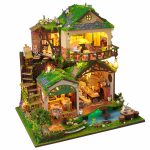




Cherry Blossom Book Nook: How to Choose a Kit That Fits Your Shelf
You’re looking at cherry blossom book nook kits and trying to figure out which one will actually look the way you imagine it — branches arching over a stone path, pink petals catching warm light, a depth that makes six inches of shelf space feel like somewhere else. This guide covers what you’re buying, what to check before you order, and how to think about difficulty level whether you’re building it yourself or giving it as a gift.
What you’re actually buying when you search ‘cherry blossom book nook’
A Book Nook is a miniature scene designed to sit between books on a shelf. You look at it from the side — the open face becomes a window into a small world. It’s not a standalone figurine, not a printed backdrop, not a full diorama. The side walls are meant to disappear against book spines, so the scene inside reads as something behind the shelf rather than on top of it.
Cherry blossom kits typically include three layers of visual structure: branch or tree elements that frame the top and sides, a ground-level scene — a path, a bridge, sometimes a temple gate — that establishes the depth, and individual petal pieces scattered across branches and ground. The warm LED string, included in every Nookcraft kit, sits behind or above the branch layer. When it’s on, the light passes through thin petal cuts and creates shadows at different depths. This is what separates a cherry blossom scene from a flat illustration of cherry blossoms.
Designing a Book Nook is harder than designing a full house kit of the same size. Not because the pieces are more complex, but because you’re compressing three-dimensional depth into a space defined by how far apart someone’s books happen to be. Every millimeter of perceived distance is designed, not found. A good cherry blossom Book Nook uses forced perspective — taller elements in the back, smaller ones in front, branches angling toward the viewer — so the insert feels deeper than it physically is.
What separates a cherry blossom Book Nook that looks real from one that looks flat
Four things determine whether finished cherry blossom scene has depth or just has pink on it.
Material. Basswood plywood is lighter than MDF and has a natural grain that catches light at different angles. When you paint or leave bare a basswood branch element, the wood grain adds a texture that MDF’s uniform surface doesn’t have. MDF is cheaper — and heavier — and the flat surface tends to read as flat in the finished piece, especially under LED light. For cherry blossom kits, where branch and petal elements are thin and detailed, the material choice shows up immediately.
Laser-cut precision. ±0.1mm tolerance means the branch elements, some of which are 2–3mm wide, cut cleanly without splintering. This matters for cherry blossom kits more than for solid-wall house kits, because the thin cuts on petals and branches are the difference between a piece that looks like wood shaped into a flower and a piece that looks like a chip of wood. Every Nookcraft kit uses laser-cut basswood at this tolerance.
Piece count. Cherry blossom kits in the 150–250 piece range typically include layered branch structures and individual petal elements you place by hand. Lower piece counts — under 100 — may mean printed panels instead of cut pieces, which reduces the dimensional effect. More pieces doesn’t automatically mean better, but for a theme built on layered branches and scattered petals, count tells you something about how much of the scene you’re building versus how much is already printed on flat panels.
Instructions. We let three people who had never touched a miniature kit build the same model and recorded where they got stuck for more than ten minutes. It was the same two steps for all three. The instructions weren’t wrong — they were written for someone who already knew what the finished piece was supposed to look like. Every Nookcraft kit ships with full-color English photo instructions, each step photographed with callout arrows showing exactly what changed from the previous step.
For more on nature-themed miniature kits, see our guide to floral and greenhouse kits.
Display and lighting: what changes after you turn off the room lights
Cherry blossom scenes are one of the themes where LED lighting makes the largest difference in how the piece reads on a shelf. In daylight, you see the structure — branches, path, petals. With room lights off and the LED on, the warm-white light passes through thin petal layers and translucent painted elements, creating depth that’s not visible otherwise. Shadows fall at different distances depending on how the wire is routed behind the branch layer. The scene goes from a small object to a small place.
Placement matters. The side walls of a Book Nook are designed to blend with book spines, and darker book covers — navy, black, deep green — work best with cherry blossom themes. The contrast between a dark spine and the warm glow inside the scene makes the opening more visible from across the room. If your shelf has lighter books, it still works; the contrast is just softer.
Two things the kit doesn’t include that you’ll need: a CR2032 button cell battery and super glue (cyanoacrylate). The LED wire and battery compartment are in the box, but battery is not — this is the most common oversight, especially for gift buyers who wrap the kit and don’t realize the recipient can’t light it without a battery they didn’t know to buy.
A dust cover is worth considering for cherry blossom kits specifically. The branch and petal elements are more exposed than the solid walls of a traditional house kit, and over time, dust settles into the fine cuts. A protective cover, sold separately, keeps the scene intact.
You can browse themed options in our bookstore and library kits collection.
Giving a cherry blossom book nook as a gift
Cherry blossom has natural gift timing: spring birthdays, Mother’s Day, Valentine’s Day, graduation. The theme reads as intentional without being tied to a specific holiday, which gives it range.
The question we hear most from gift buyers is about difficulty. If you don’t know the recipient’s skill level, start with an intermediate kit — roughly 4 to 7 hours of build time. Intermediate kits have enough detail to feel like a real project, with layered branches and individual petals, but they don’t require prior experience with miniature assembly. Advanced kits (8 to 15 hours) are better for someone who’s already built at least one kit and knows how to manage fine glue work and LED routing.
Real assembly time is 30 to 40 percent more than what the box declares — based on tracking across our test builds. We recommend planning for two sessions, not one. If you’re giving this as a gift, that framing helps: this is a two-afternoon project, not a single sitting. The second session is almost always better — the glue has cured, you’re not rushing, and the final petal placement and lighting is the part people actually enjoy most.
If you want to make the gift immediately usable, include three things the kit doesn’t ship with: a CR2032 battery, a small bottle of super glue, and optionally a dust cover for long-term display. Nothing worse than handing someone a kit they can’t start because they’re missing adhesive they didn’t know to buy.
For more on getting started with miniature kits, see our beginner guide to miniature kits.
Difficulty and time: what ‘intermediate’ actually means for a cherry blossom build
Nookcraft kits are labeled Intermediate (~4–7 hrs) or Advanced (~8–15 hrs). We don’t label anything as beginner because our kits have real structural complexity — laser-cut joinery, LED wire routing, multi-layer assembly. Calling something ‘beginner’ when it takes five hours and has 200 pieces isn’t honest, and we’d rather tell you what you’re getting into.
In cherry blossom kits, two areas tend to slow builders down. The first is branch assembly — the parts are thin, the glue placement has to be precise, and a branch that’s off by a millimeter affects everything that attaches to it above. The second is LED wire routing. In test builds, threading the copper wire through anchor points was a universal sticking point. The instruction manual now includes a warning at that step: keep glue away from wire ends, because contact causes intermittent failure. One buyer email traced that problem. One fix, still in the manual.
Splitting the build across two sessions isn’t a compromise — it’s the better way to do it. First session: structure, walls, main architectural elements. Let the glue set overnight. Second session: detail work — branches, petals, LED positioning, final adjustments. In our experience, the second session takes less time than you’d expect, because the foundational joints are solid and you’re working with a stable frame instead of balancing pieces while the glue is still wet.
Every kit ships with full-color English photo instructions. Not illustrated diagrams — photographs of the actual kit at each step, with callout arrows showing where each piece goes and what changed from the step before.
Frequently asked questions
What size battery does a cherry blossom Book Nook need?
CR2032 button cell. It’s not included in the kit — you’ll need to buy one separately. This is the most common thing gift buyers miss.
How long does it take to build a cherry blossom Book Nook kit?
Intermediate kits: 4–7 hours. Advanced kits: 8–15 hours. Real assembly time runs 30–40% longer than the box estimate. We recommend splitting across two sessions — structure and walls first, detail work and lighting second.
Can I build a cherry blossom Book Nook if I’ve never done a miniature kit before?
Intermediate kits are manageable for first-time builders who follow the instructions step by step. Each kit includes full-color English photo instructions with callout arrows, not just angle shots. If you’re unsure, start with intermediate rather than advanced.
Does the LED light come with the kit?
Yes. Every Nookcraft kit includes a warm-white LED string with wire and battery compartment. The CR2032 battery is not included. Super glue is not included either.
What should I pair with a cherry blossom Book Nook as a gift?
Three things the kit doesn’t include: a CR2032 battery, a small bottle of super glue (cyanoacrylate), and optionally a dust cover for long-term display. Adding these to the gift means the recipient can start building right away and keep the finished piece protected.
If a cherry blossom scene between your books sounds like the right kind of project, you can find the current kit options in our bookstore and library kits collection — each one has the full spec, difficulty level, and a look at what’s inside the box.