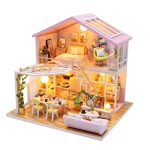
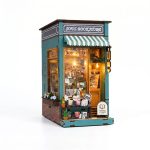
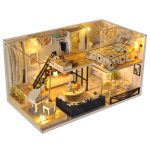
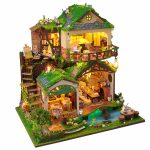




Where to Buy Miniature House Kits: What to Check Before You Order
The search “where to buy miniature house kits” returns hundreds of listings in under a second. Finding a kit is not the hard part. Knowing which one arrives with instructions you can follow, in material that holds a clean joint, within the time the listing promised — that is the part most buyers get wrong on the first try.
Before you compare platforms or scroll through pages of listings, take thirty seconds to ask: what am I building for? The answer changes where you should buy and what you should look for.
The First Question Isn’t Where to Buy — It’s What You’re Building For
A miniature house kit can be a satisfying weekend project or something that sits half-finished on your desk for three months. The difference is rarely the kit itself — it is whether the kit matched what you needed going in.
Three scenarios cover most buyers:
You have never built a miniature kit before. You need instructions that show every step clearly, not skip ahead because the designer assumed you already knew what a butt joint looks like. Instruction clarity matters more than piece count or scene theme.
You have built two or three kits and want to upgrade. You care about material — whether parts are laser-cut basswood or MDF, whether joints are tight enough to hold without clamps. You are comparing specs now, not just photos.
You are buying for someone else. You do not plan to build it yourself, but you need to know it will arrive complete, with clear instructions, and that the recipient can actually finish it. Return policy matters here more than anywhere else.
There is also physical constraint to consider. Where does the finished piece go? If it sits on a bookshelf between books, creating depth visible from the side, that is Book Nook format — and it requires tighter dimensional design than a standalone display model. Compressing three-dimensional depth into a space defined by how far apart someone’s books happen to be means every millimeter is designed, not found. If you want to browse miniature house kits by scene theme, knowing your display space first saves you from choosing a kit that does not fit.
Where People Buy Miniature House Kits — and What Each Source Gets Right (and Wrong)
Based on kits we have tested and buyer feedback we have collected, four main buying channels emerge. Each has a pattern.
Amazon is where most people start. Largest selection, fastest shipping, price range from about $15 to $60. The problem — and this is based on our direct experience — is that difficulty levels are often labeled incorrectly. A kit marked “beginner” might have 200+ pieces and instructions that assume you have built five kits before. Many arrive with Chinese-only manuals or with step photos so compressed you cannot tell which piece is which. I bought my first three miniature kits on Amazon. First one had instructions entirely in Chinese — I used a translation app step by step. Second had English text but images were compressed thumbnails where parts blurred together. Third, I got halfway through and started redrawing the diagrams on paper because the original ones were not helping.
Etsy offers more artisan-level options. You will find kits there that do not exist on Amazon — custom designs, smaller-batch production. Quality control, though, depends entirely on the individual seller. Return policies vary. Some sellers respond to missing-piece emails within hours; others never respond at all. When buying on Etsy, check the seller’s review history for specific comments about instruction quality and kit completeness.
Direct-to-consumer brand sites — companies that sell only their own kits — have the smallest selection but typically offer more specific product information. They name the wood. They show real step photos. They tell you assembly time is seven hours, not three. The reason is straightforward: the person answering your email probably built the kit herself.
Hobby and craft stores carry some miniature kits in-store, but stock is limited and usually skewed toward lower-piece-count sets. Better use of a craft store visit: pick up the tools you will need — super glue, precision tweezers, a craft knife — while ordering the kit online.
The pattern across all four: the more mass-market the platform, the less control you get over instruction quality and material transparency. This is not universal — good kits exist on every platform — but it is the trend. Our records from buyer emails show that most “where is step 23?” questions come from kits purchased through large marketplace platforms where instruction design was clearly an afterthought. If you are new to building and not sure what to expect, our beginner miniature house kit guide covers what the first build actually looks like — tools, time, and common sticking points included.
Five Things to Check Before You Add a Miniature Kit to Cart
These five criteria apply regardless of where you buy. Use them as checklist on any listing.
1. Material. Does the listing name it? “Wood” is not enough. Laser-cut basswood is lighter than MDF, has visible natural grain, and cuts at ±0.1mm tolerance — which means snap-fit joints actually snap together and stay. MDF is heavier, does not take paint as well, and is less forgiving when tolerances are loose. If listing does not specify material, that is information in itself.
2. Instructions. Full-color English photo instructions — one photo per step, with arrows or callouts showing exactly where each piece goes — are what you need. If listing shows compressed images or does not show sample instruction pages, assume the worst. In our experience, the instruction problem usually surfaces around steps 22–25, where assembly moves from “put two big pieces together” to “orient these six small pieces in the correct order.” That is where vague diagrams become real frustration.
3. Time honesty. Does the listing say “3 hours” or “4–7 hours, best split across two sessions”? In our experience, declared assembly time usually reflects the fastest possible speed if nothing goes wrong. Realistic time is 30–40% longer. Sellers who give you a range — and recommend splitting the build — have usually tested it themselves.
4. What is included. LED string included or not? Battery included or usually not? Super glue — almost never included, and you will need it. Dust cover sold separately or included? The gap between “kit” and “everything you need to finish” is where surprise costs live. Button cell battery (CR2032) is the item buyers forget most often.
5. Return and replacement policy. Can you get a free replacement for a missing or damaged piece, or are you on your own? A 30-day return window with free part replacement — no photo proof required — is the standard to look for. One buyer emailed us because her LED stopped working on day three. We traced it back to glue that had seeped into wire joint during final assembly push. That specific failure is why our step 29 now has a warning box: keep glue away from wire ends. If your seller’s response to that email would be “too bad,” find a different seller. For kits that combine floral and miniature elements, our miniature greenhouse and floral kits page shows how botanical details work in laser-cut basswood.
How Nookcraft Handles the Buying Decision
I started Nookcraft after four years designing book layouts at a small independent press. The instinct I brought from that work is not about aesthetics — it is about information design. Can someone look at step 37 and know exactly what to do without guessing? That question is what I test for with every manual we ship.
Every Nookcraft kit ships with full-color English photo instructions — not translated from another language, not compressed thumbnails, designed from scratch. Our instructions start at step 3, because the first two steps are desk preparation and manual scan. Every other manual I have seen skips those and assumes you are ready to go. We do not assume.
Difficulty levels are honest. Intermediate kits run 4–7 hours. Advanced kits, 8–15 hours. We do not label a 200-piece kit “beginner” to lower the barrier to purchase. We recommend building best split across two sessions — session one for the structural base, session two for details and finishing. In our experience, the second session is where the build actually becomes something you sit with, because the glue has set and you are not rushing.
Every kit includes laser-cut basswood at ±0.1mm precision and LED string included in every kit, along with full-color English photo instructions. We are explicit about what is not included: battery (button cell, CR2032) and super glue — because we would rather tell you upfront than let you find out at step 12.
If a piece arrives missing or damaged, we ship replacement parts free — 30-day returns, no photo proof required. This is not a generous policy. It is baseline.
Browse miniature house kits for adults — every kit page lists exact piece count, assembly time estimate, and difficulty level so you can decide before you order.
Frequently Asked Questions
Where is the best place to buy miniature house kits online?
Direct-to-consumer brand sites typically offer the most transparent product information — named materials, real step photos, clear return policies. Amazon has the widest selection but instruction quality varies significantly. Etsy depends on the individual seller. Wherever you buy, look for a source that specifies wood type, shows instruction samples, and has a documented replacement policy.
What is the difference between a miniature house kit and a Book Nook kit?
A miniature house kit is a standalone display model. A Book Nook is specifically shaped to fit between books on a shelf, creating a diorama visible from the side. Book Nooks require tighter dimensional constraints — every millimeter of perceived depth is designed around the space between your books.
Are miniature house kits hard to build?
Intermediate kits take 4–7 hours. Advanced kits take 8–15 hours. We recommend splitting any build into two sessions. Difficulty comes from instruction clarity, not the complexity of the kit itself — a well-designed manual makes the same complexity feel manageable. If you have never built one before, start with an Intermediate-rated kit and give yourself a full afternoon.
Do miniature house kits come with everything you need?
Most kits include wooden parts, LED string, and instructions. Batteries (usually button cell / CR2032) and super glue are almost never included. Check the listing for exact inclusions before ordering — the gap between “kit contents” and “everything you need to finish” is where surprise costs live.
If you have read this far, you probably have a shelf space in mind already. Browse our miniature house kits to find the scene that fits — every kit lists its exact piece count, assembly time, and difficulty level.