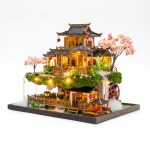



What Is a Miniature House? A Practical Buying Guide
When someone asks me what is miniature house kit actually about, I don’t start with “it’s a tiny building.” I start with the shelf. You have books, and between those books there is a gap — sometimes four inches wide, sometimes six. A miniature house is a scale model scene designed to live in that gap, or on a nearby surface, turning empty space into something you built with your own hands. Most kits arrive as laser-cut wooden parts, an LED light string, miniature furniture, and a set of step-by-step instructions.
That is the short version. The longer version involves understanding scale, materials, difficulty levels, and which type of miniature house is actually right for your shelf and your patience. This guide covers all of it.
What Exactly Is a Miniature House?
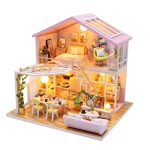
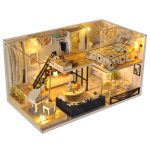
A miniature house — sometimes searched as “house miniature” or “house of miniature” — is a scale model of a real or imagined interior scene. Think of it as a snapshot of a room: a kitchen counter with two cups, a reading nook with a lamp, a flower shop with tiny pots on shelves. You assemble it from a kit, piece by piece, usually over several hours.
The most common scales are 1:12 and 1:24. At 1:12, one inch of the model equals one foot of the real thing. A 1:24 kit is half that — smaller details, tighter workspace, more precision required. Scale matters because it determines whether third-party accessories (like miniature books or plant pots) will fit with what you already own.
This is different from a dollhouse. A miniature doll house, in the way we use the term at Nookcraft, is not meant for play. It is display-oriented. You build it, wire the LED, set it on your shelf, and it stays there. No opening doors for small hands, no rearranging furniture for a child’s story. The person we picture standing in front of that shelf is an adult — someone who wants a bookshelf that tells a story, and that story started with their own hands.
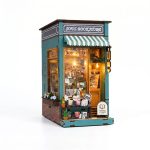
One of the fastest-growing subtypes is the Book Nook: a miniature scene shaped to slide between books on a shelf. Viewed from the side, it creates the illusion of depth, like there is a tiny alleyway or a cozy room behind your book spines. Designing Book Nooks is harder than it looks — you are compressing three-dimensional depth into a space defined by how far apart someone’s books happen to be. Every millimeter of perceived depth is designed, not found.
For a full breakdown of what to expect when starting out, the beginner guide to miniature houses covers kit selection, tools, and realistic time planning.
Types of Miniature Houses: From Cottagecore to Book Nooks
Miniature houses come in a range of visual themes. Here are the main categories:
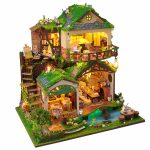
- Cottagecore and floral scenes — Greenhouses, flower shops, garden sheds. These kits lean into the Cottagecore aesthetic: natural materials, plants, warm light. Our miniature greenhouse and floral kits fall into this category.
- Urban and architectural scenes — Bookstores, coffee shops, street corners. Often include detailed signage, tiled floors, and window displays.
- Fantasy and whimsical scenes — Potion shops, treehouses, secret libraries. The appeal is in the imagined world, not the realistic one.
- Book Nook inserts — Slim-profile scenes designed specifically to fit between books. Space-efficient and create the most dramatic visual effect on a shelf.
Most Nookcraft kits are labeled Intermediate (approximately 4–7 hours assembly) or Advanced (approximately 8–15 hours). We do not currently have beginner-level kits — the smallest piece count starts around 150 parts, which is enough to build something meaningful but not something you finish in one sitting. For design inspiration across all themes, see our miniature design ideas for bookshelves — over 20 scene concepts to browse.
How to Choose a Miniature House Kit: 5 Key Criteria
Here are the five things I check before recommending a miniature DIY house kit to anyone.
1. Difficulty level and assembly time
We label every kit as Intermediate (approximately 4–7 hours) or Advanced (approximately 8–15 hours). These numbers are based on real build testing, not fastest-case scenarios. In our experience, declared assembly times across the industry usually reflect how fast someone could go if nothing went wrong. We add 30–40% to that and tell buyers to plan for two sessions, not one. The second session is almost always better — glue has set, you are not rushing, and you can actually enjoy the final steps.
2. Piece count
Total number of laser-cut components. This is the primary indicator of complexity and richness. A 150-piece kit is manageable for a first build. A 350-piece kit has more detail but requires more patience and more table space.
3. Material: basswood versus MDF
Laser-cut basswood plywood is lighter, has a finer grain, and cuts cleanly to ±0.1mm precision. That tight tolerance means joints fit together without forcing. MDF (medium-density fiberboard) is cheaper, heavier, and produces a less attractive finish. Most kits in the market use one or the other — check the product description before buying.
4. What is included
Every Nookcraft kit includes a warm-white LED string with wire and battery compartment. Batteries are not included — most kits use a button cell (CR2032) that you need to purchase separately. Super glue is also not included; you supply your own.
5. Support and returns
Look for a clear return policy before you order. Nookcraft offers 30-day returns and free replacement parts for missing or damaged pieces. This matters more than people expect — when you are on step 89 and a piece is missing, the difference between “email us and we ship it” and “buy another kit” is the difference between finishing the build and not finishing.
Ready to compare options? Browse miniature house kits for adults in our collection.
Getting Started: What You Need Before Your First Build
Before you open the box, here is what to prepare:
Workspace. A flat, well-lit surface. The biggest frustration I see from first-time builders is not the difficulty of the kit — it is bad lighting. You need to see the printed instructions clearly and you need to see small parts without squinting.
Super glue. Cyanoacrylate adhesive, fast-curing, strong bond on wood. Buy a small tube with a precision tip. This is the one supply every miniature house kit requires and no kit includes.
A willingness to stop and come back. When I designed the first Nookcraft instructions, I spent three days deciding what step 1 actually is. You have not cleared your desk yet, you have not scanned the whole manual, you do not know what is coming. So our instructions start at step 3 — the first two steps are preparation, and they are the two steps nobody ever includes. Most builders who get stuck on step 23 could have avoided the problem if they had read through the manual first.
Patience with the LED wire. The LED string is included in every kit, but threading copper wire through small anchor holes is one of the steps where builders get stuck most often. I traced one buyer’s issue back to glue seeping into the copper wire joint at step 29 — that is why that step now has a warning box: keep glue away from wire ends.
Once your doll house miniature build is complete, consider a dust cover. It protects the finished piece from dust and accidental bumps, especially important if you have it on a shelf you walk past every day. The LED light adds a warm glow to the scene when you turn off the room lights — that is the moment most builders tell me made the hours worth it.
If you are new to building and want a gentle first project, our floral and greenhouse miniature kits have some of the most visually satisfying builds. The natural elements are forgiving if a piece is slightly off alignment.
Frequently Asked Questions
How long does it take to build a miniature house kit?
Realistic assembly time is 30–40% longer than what most boxes declare. For Nookcraft kits, plan 4–7 hours for Intermediate and 8–15 hours for Advanced. We recommend splitting the build across two sessions. The second session goes faster because the glue from the first session has cured and you are already familiar with the parts.
What tools do I need to assemble a miniature house?
You need super glue (cyanoacrylate with a precision tip), a clean flat surface, and good lighting. Everything else — laser-cut parts, LED string, miniature accessories, and full-color English photo instructions — comes in the kit. Batteries (typically CR2032 button cells) are not included.
Are miniature houses difficult to assemble?
It depends on the kit. Intermediate kits (150–250 pieces, 4–7 hours) are manageable for most adults with no prior experience, as long as you follow the instructions step by step. Advanced kits (300+ pieces, 8–15 hours) have smaller parts and more intricate assembly sequences. The honest answer: if you can follow a recipe with 15 steps, you can build an intermediate miniature house.
Can I customize or paint my miniature house?
Yes. Basswood takes paint well — acrylic works. But I recommend building the kit as designed first, then deciding on modifications. Understanding how the pieces fit together makes customization more successful and less frustrating.
Where should I display my finished miniature house?
Bookshelves are the most common location, especially for Book Nooks designed to fit between books. Desks and mantels also work. Wherever you place it, keep it out of direct sunlight for long periods — UV can fade paint over time. A dust cover is worth the investment if the piece is in a high-traffic area of your home.
Ready to start building your own miniature world? Find the right kit for your skill level and interests — browse our miniature house kits collection.