




Miniature House Gift: How to Choose the Right Kit for Someone Else
A miniature house kit is one of the more deliberate gifts you can give — not because it’s expensive, but because the recipient will spend somewhere between 4 and 15 hours with the thing you chose for them. That’s a lot of someone else’s Saturday afternoon to be responsible for. This guide covers the three decisions that matter most: matching difficulty to experience, picking a scene they’ll actually want to finish, and knowing what’s in the box so the gift works the moment it’s opened.
What makes a miniature house kit worth giving
Most gifts are chosen in under a minute. A miniature house gift asks for a few real decisions — not difficult ones, but specific ones. You’re not picking a color or a size. You’re picking how someone will spend their free time, and whether they’ll enjoy it enough to finish.
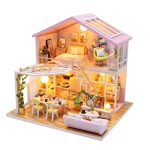
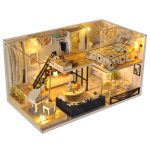
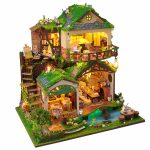
The kits themselves are designed for adults. Each one is a three-dimensional scene — a café interior, a bookshop corner, a greenhouse with climbing vines — made from laser-cut wooden parts that slot together following a step-by-step instruction booklet. The finished piece sits on a shelf, or between books, and the LED string inside lights up a world that didn’t exist six hours ago.
But before you pick one, you need to know three things about the person you’re buying for. Their experience with hands-on projects. What kind of scene they’d want to look at when it’s done. And whether you’ve told them about the glue.
If you’re completely new to this category, our beginner miniature house kit guide covers kit selection, tools, difficulty levels, and time planning in more detail.
Decision 1: Know their experience level
Nookcraft kits come in two difficulty levels, and we don’t soften the labels. Intermediate kits take approximately 4–7 hours. Advanced kits take 8–15 hours. These are the ranges you’ll see on the product page, not aspirational estimates for the fastest possible builder.
In our experience, the real assembly time runs 30–40% longer than what’s on the box — not because the instructions are unclear, but because nobody builds at maximum speed for seven hours straight. Most builders do their best work splitting the project across two sessions. The first session gets you through the structural assembly. The second session, with the glue already set and the pressure off, is where the smaller details and the lighting come together.
If the recipient has already built a kit or two and talks about the process — not just the result — an Advanced kit gives them something to work through over several evenings. It’s a different kind of gift. Less “here’s something fun,” more “here’s something that will keep you occupied in a way you enjoy.”
Decision 2: Pick a scene they’ll want to build
A house miniature kit is only a good gift if the recipient wants to spend hours looking at it in close-up while they assemble it. The scene matters — not as decoration, but as motivation. Someone who finishes a kit does so because they want to see that specific corner of the miniature world come together.
There are two formats to choose from. A Book Nook insert is a miniature scene designed to sit between books on a shelf. Viewed from the front, it creates the illusion of a world extending behind the bookcase — a narrow alley, a shop doorway, a garden passage. A standalone miniature house kit sits on a desk or shelf as a complete three-dimensional structure. Both work as gifts. The choice depends on where the recipient will put it.
Think about what they gravitate toward in real life:
- Someone with houseplants on every windowsill might enjoy a floral greenhouse miniature kit — a glass-roofed structure filled with tiny potted plants and a copper watering can.
- Someone who has a favorite coffee order and reads in cafés might prefer a two-story bookshop with a café counter on the ground floor.
- Someone who collects old books and maps — a library scene with ladders and reading lamps.
For a full look at available themes and aesthetics, the miniature house design ideas page covers 20-plus scene options across different moods and settings. Browsing it takes about three minutes. Picking the right one is worth those three minutes.
Decision 3: Know what’s in the box (and what isn’t)
Every Nookcraft miniature diy house kit includes:
| Included in the kit | Not included |
|---|---|
| Laser-cut basswood parts (±0.1mm precision) | Super glue (cyanoacrylate) |
| Warm-white LED string with wire | CR2032 button cell battery |
| Full-color English photo instructions | — |
Two items the recipient will need on hand: a tube of super glue and one CR2032 battery. These are small, inexpensive, and available at any pharmacy or hardware store — but they’re not in the box.
Telling the person you’re buying for that they’ll need glue and a battery is not spoiling the surprise. It’s the difference between opening a gift on Christmas morning and opening a box that sits on the kitchen table for two days until someone remembers to buy a battery. One of those is a weekend project. The other is a delayed errand.
A note on instruction quality: after we traced one buyer’s LED failure back to glue seeping into a wire joint during final assembly, we added a specific warning box at the relevant step — “Keep glue away from wire ends — contact causes intermittent failure.” That warning is still in every manual. The instructions are designed for someone who has never built a miniature kit before, with callout arrows showing exactly which piece moved between steps.
If anything arrives missing or damaged, we ship replacement parts free of charge under our 30-day return policy. In our experience, this covers about 2% of orders, usually from transit damage rather than packing errors — but it gets fixed either way.
You can browse all available miniature house kits for adults on the collection page, sorted by difficulty, scene type, and size.
Three mistakes gift buyers make
Mistake 1: Choosing by piece count alone
A 350-piece doll house miniature kit looks more impressive than a 180-piece one on paper. But if the recipient has never built anything like this before, that higher piece count is a recipe for an unfinished project sitting in a drawer. Match the difficulty to their experience, not the impressiveness to your budget. An Intermediate kit they finish and display is worth more than an Advanced kit they abandon at step 47.
Mistake 2: Not mentioning glue and batteries
This is the most common reason a miniature house gift doesn’t get started on the day it’s given. The recipient opens the box, reads the instructions, and realizes they can’t begin. If you want the gift to work immediately, tuck a small tube of super glue and a CR2032 battery into the wrapping. Total added cost: under $5. Total difference in experience: significant.
Mistake 3: Assuming “DIY” means quick
The most common question we hear from new builders after step 20 is some version of “I got to step 23 and I can’t tell what changed from step 22.” This isn’t a sign of doing it wrong — it’s the point where the project shifts from broad assembly to fine detail. The person you’re buying for needs to know this is a multi-session project. Framing it as “something to do over a few quiet evenings” sets the right expectation from the start. If you want to prepare them further, our beginner miniature house kit guide walks through what to expect at each stage.
A gift that holds still for the parts that matter
The value of a miniature house kit as a gift is not the finished object sitting on the shelf — although that part is satisfying. It’s the hours the person spends building something with their hands, one piece at a time, in a room with the phone in the other direction.
When the LED light turns on for the first time, at whatever step that happens in the sequence, they’ll remember the evening they spent getting there. The glue that stuck to their finger. The tiny chair they almost dropped. The moment the roof tiles finally lined up after the third attempt.
This is a gift that asks someone to sit down and focus on one thing. That’s increasingly rare, and it’s the part that actually says something about how you see the person — not what they need, but what they deserve to do with their time.
Frequently asked questions
What if the person I’m buying for has never built a miniature kit?
Start with an Intermediate-level kit — approximately 4 to 7 hours of build time. Nookcraft kits come with full-color English photo instructions designed for first-time builders, so no prior experience is needed. Just patience and a willingness to follow steps. Include a note that they’ll need super glue and a CR2032 battery to get started.
Do miniature house kits come with everything needed to build them?
Nookcraft kits include all laser-cut basswood parts, a warm-white LED string with wire, and printed step-by-step instructions. The only two items not in the box are super glue (cyanoacrylate) and a CR2032 button cell battery. These are available at most pharmacies and hardware stores.
What if a piece is missing or damaged when the recipient opens the kit?
We offer free replacement parts for any missing or damaged pieces, covered under our 30-day return policy. The recipient or the gift buyer can contact us directly and we’ll ship the replacement at no cost.
How long does it take to build a miniature house kit?
Intermediate kits take approximately 4–7 hours; Advanced kits take 8–15 hours. Based on the builds we’ve tracked, adding 30–40% to the published estimate gives a realistic timeframe. Most builders split the project across two sessions — one for the main structure, one for the details and lighting.
Ready to find the right kit? Browse miniature house kits sorted by difficulty, scene, and size →