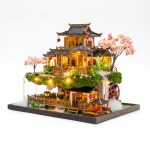



Miniature House Furniture: How to Choose the Right Scale, Style, and Material for Your Kit
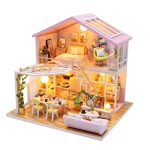
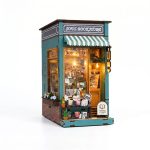
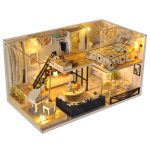
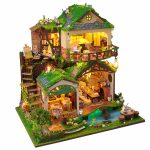
Miniature house furniture is what makes a DIY scene feel like a room someone actually uses. The tiny bookshelf with six separate shelves. The café table with a chair pulled out. The workbench with a clamp no bigger than a grain of rice. These are not decorations glued on after the walls are up — they are laser-cut components you assemble as part of the full interior, positioned and lit within the scene. If you’re looking at miniature house furniture for the first time, the question is usually: how do I tell one kit’s furniture apart from another’s? This guide covers the three criteria that matter — scale, material, and assembly complexity — and then helps you match furniture style to the story you want your finished scene to tell.
What Is Miniature House Furniture?
Miniature house furniture refers to scale-model interior pieces — tables, chairs, bookshelves, lamps, kitchen counters, display cabinets — built at a fixed ratio to real objects. The two standard scales are 1:12 (one inch in the model equals one foot in real life) and 1:24 (half that). In a well-designed kit, every furniture piece is cut to the same scale, so when you look into the finished scene, the room reads as one coherent space.
These furniture pieces are almost always included components of a DIY miniature house kit, not items sold individually. A typical adult-oriented kit arrives as a set of laser-cut wooden sheets, sometimes with fabric, metal wire, or paper accessories. You punch or cut the parts from the boards, follow the step-by-step assembly sequence, and build the furniture as part of the larger scene — walls, flooring, lighting, and all.
This is different from toy furniture. Toy furniture is made to be handled, moved, and played with. Miniature house furniture in an adult kit is designed to be assembled piece by piece — often 15 to 30 parts per single item — using precision-cut joints that fit within ±0.1mm tolerance. The activity is focused, screen-free construction that produces something worth displaying on a shelf. If you’re new to the category, our beginner miniature house kit guide covers kit structure, tools, and what to expect from your first build.
Choosing by the Numbers: Scale, Material, and Assembly Time
When comparing kits, three numbers tell you most of what you need to know.
Scale Compatibility
If you already own a 1:12-scale Book Nook, a 1:24-scale furniture set will look wrong next to it — the chairs will be half the height they should be. Before buying, confirm the scale is stated on the product page. Most adult-oriented kits use 1:12, but some compact Book Nook inserts use 1:24 to fit narrower shelf depth. Stick to one scale across your shelf if you plan to display multiple scenes side by side.
Material: Basswood vs. MDF
The two materials you’ll encounter are basswood plywood and MDF board. Basswood is light, has a visible fine grain, and takes paint well if you want to customize. MDF is heavier with a uniform surface and no grain — it works, but the finished pieces feel different in hand. Kits designed for adults tend to use laser-cut basswood. The precision of the cut matters: laser-cut basswood parts fit together with snap-fit joints that hold during assembly, while lower-tolerance cuts leave gaps that need more glue and more adjustment.
Piece Count and Build Time
Higher piece count means more detailed furniture — a miniature bookshelf with individually adjustable shelves, for example, versus one solid panel. But more pieces also means more time. We label our kits as Intermediate (~4–7 hours) or Advanced (~8–15 hours). Based on our testing, the declared assembly time is usually what a competent builder could achieve if nothing went wrong. We add 30–40% to that number. A kit marked 6 hours is more realistically an 8-hour build, and it’s best split across two sessions. The second session is almost always better — glue has set, you’re not rushing, and you can actually enjoy the details.
The LED Factor
Every Nookcraft kit includes an LED string. This is not a decorative afterthought. The way light falls across miniature furniture creates depth and shadow that make the scene look like an actual room. When you’re assembling furniture inside the kit, position pieces so the LED source creates a visible light-dark pattern — a lamp on a side table, a shadow under a shelf, a warm glow through a window. Furniture placement and lighting design are the same decision.
For more on how different themes use furniture and light together, see our miniature house design ideas page with over 20 scene themes.
Furniture as Story: Matching Style to Your Scene’s Theme
Doll house miniature furniture is not just functional — it tells you what kind of room you’re in before you read any other detail. A rustic trestle table with mismatched chairs says farmhouse kitchen. A sleek espresso machine and two bistro chairs say café at 4 p.m. A tall narrow bookshelf with a reading lamp and an armchair says someone lives here and they read past midnight.
The style of the furniture defines the narrative. In a cottagecore-themed kit, you’ll find natural wood tones, floral fabric cushions, and open shelving with tiny jars. In a library Book Nook, the furniture is heavier — dark-stained bookcases, textured chairs, a globe on a side table. Each furniture set is designed as a complete interior, not a random collection of objects. Arrangement matters: a chair pulled close to a window tells a different story than one pushed into a corner. Browse design inspiration for 20+ scene themes →
There’s range, too. If your taste runs toward the unusual, you might search for something like miniature haunted house furniture — candelabras, Victorian settees, mantels with cobweb detail. The niche is smaller, but it exists, and the same evaluation principles (scale, material, assembly time) still apply. If nature and botanical scenes are closer to what you’re imagining, our miniature greenhouse and floral kits cover scenes with plant stands, potting benches, and glass-pane structures.
One thing worth noting: Book Nook kits are harder to design than full house kits of the same size — not because the pieces are more complex, but because you’re compressing three-dimensional depth into a space defined by how far apart someone’s books happen to be. Every millimeter of perceived depth is designed, not found. This affects furniture proportion, spacing, and how much visual detail can fit without the scene feeling crowded.
What to Look For in a Kit: A Practical Checklist
When you’re on a product page, here’s what I’d check:
- Scale stated clearly — Is it 1:12 or 1:24? Does it match what you already own or plan to buy?
- Material listed — Does the listing say laser-cut basswood, or is it MDF? If the material isn’t stated, that’s a flag.
- Piece count — A kit with 150–250 pieces will have more detailed furniture than one with 80–120. More pieces also means more time, so be honest about how many evenings you want to spend.
- Difficulty label — Look for Intermediate or Advanced, not just a vague “skill level.” If a kit says it takes 4 hours, ask yourself: is that the real number, or the optimistic number?
- Instructions in your language — Are they photo-based or line drawings? At Nookcraft we provide full-color English photo instructions because we’ve seen what happens when step 22 and step 23 look almost identical and nobody draws a clear difference. A buyer once emailed us about an LED failure that traced back to a glue contact issue at step 29. That step now has a warning box. Good instructions are updated instructions.
- Return and replacement policy — Can you get a free replacement if a piece arrives cracked or missing? We offer 30-day returns and free replacement parts for missing or damaged pieces. This should be standard, not a perk.
Frequently Asked Questions
What’s a good starter furniture theme for a first Book Nook?
A library or coffee shop scene. Both have recognizable furniture shapes — bookshelves, tables, chairs — that make it easier to judge scale and assembly as you build. They also photograph well on a shelf, which matters more than people expect.
Can I mix miniature furniture from different kits?
Technically yes, if the scale matches (only 1:12 with 1:12, or 1:24 with 1:24). But style consistency is harder to control — a modern café chair next to a Victorian writing desk can look intentional or accidental depending on the scene. For a first project, sticking to one theme is simpler and the result usually looks better on the shelf.
How important is lighting for miniature furniture?
Very. An LED string creates shadows and highlights that make flat wooden surfaces look three-dimensional. Furniture should be arranged with the light source in mind — a table lamp positioned under the LED reads as “lit,” while the same lamp in shadow reads as “off.” Every Nookcraft kit includes an LED string because without it, the scene loses half its depth.
Ready to build a scene? Browse miniature house kits for adults to find a theme and furniture set that fits your shelf and your schedule →