



Miniature General Store Kit: How to Choose One That Looks Right on Your Shelf
Shopping for a miniature general store kit means making three decisions before you even open the box: how much interior detail you want, how many hours you can give to assembly, and whether the material will hold the joints this kind of scene demands. A general store lives or dies on what’s behind the counter — the rows of jars, the wall shelving, the register on a 12mm-wide countertop. If the kit cuts corners on piece count or wood quality, that’s where you see it. This guide walks through what actually matters when choosing a miniature store kit, based on the builds we’ve tested and the questions buyers send us most.
What a General Store Scene Needs to Get Right
General store scenes are interior-heavy. Unlike a cottage facade where you see the roof and front wall and call it done, a general store is a box you look into. Counter depth, shelving with scaled goods, a cash register, signage above the door — all of it needs to fit in a space that might be 8 to 15 centimeters deep.
According to our knowledge base, kits with fewer than 100 pieces usually simplify or remove the interior props that make a store look like a store. The shelving becomes flat painted surfaces instead of actual recessed slots. The goods disappear. What you’re left with is a building shape, not a shop.
Three things separate a convincing general store from a wooden box:
- Interior depth. The scene needs enough recession that the back wall isn’t touching the front facade. In Book Nook kits, this is a design challenge — you’re compressing three-dimensional depth into a space defined by how far apart someone’s books happen to be. Every millimeter of perceived depth is designed, not found.
- Scale consistency. A 1:24 scale store and a 1:12 scale store look fundamentally different on the same shelf. Mixing scales breaks the illusion. Check the spec before you buy — most listings state the ratio, and it affects compatibility with third-party accessories later.
- Lighting. In a store interior with four walls, without a light source the back wall disappears into shadow. LED lighting isn’t decorative at this scale — it’s structural visibility. Every Nookcraft kit includes a warm-white LED string for this reason.
Material matters too. Laser-cut basswood at ±0.1mm precision means the shelving joints sit flush and the counter edges line up clean. MDF kits at this scale often have visible gaps where thin shelf boards meet the walls. For a scene that depends on rows of parallel shelving, those gaps show. If you’re interested in more advanced scene-building — diorama-style kits with layered depth and lighting — our miniature diorama kit guide covers what to expect from those builds.
Three Questions Before You Buy a Miniature Store Kit
Instead of comparing products side by side, ask yourself these three things. They’ll narrow the field faster than any feature table.
Question 1: How many pieces?
Piece count is your fastest proxy for interior detail. Below 120 pieces, expect simplified interiors — maybe a counter and one shelf, but not the rows of goods and signage that define a general store. Between 150 and 250 pieces is where the scene gets shelving, jars, a register, hanging scales, and exterior signage without becoming an 8-session project. Above 300, you’re in advanced territory — rewarding, but plan for it.
Question 2: How long will it actually take?
Declared assembly times are fastest-case scenarios — the time a competent builder could hit if nothing went wrong and they never paused to check the diagram. Based on the kits we’ve tested, add 30–40% to whatever the box says. A kit labeled 6 hours typically takes closer to 8.5 hours. We recommend splitting across two sessions. The second session is almost always better — glue has set, you’re not rushing, and you can actually enjoy fitting the small counter details that are the whole point of a general store scene.
For reference: intermediate kits range from 4 to 7 hours. Advanced kits run 8 to 15 hours. If this is your first build, our beginner kit selection guide has a full breakdown of what difficulty levels mean in practice.
Question 3: Basswood or MDF?
Laser-cut basswood holds fine joints at this scale — the edges are clean, the fit is tight, and the wood grain gives a warm finish. MDF is heavier, and the edges don’t clean up as well after cutting. For a scene with a lot of thin shelving, the difference is visible in the finished piece. Most kits in the intermediate-and-up range use basswood, but check the spec sheet — some budget listings say “wood” when they mean MDF.
One more check: instruction language
Full-color photo instructions in English with callout arrows reduce the most common sticking point we hear about. Our records show the number one email from new builders is some version of: “I got to step 23 and I can’t tell what changed from step 22.” That’s an instruction problem, not a user problem. If the listing doesn’t show sample instruction pages, assume the worst.
What Building a Miniature Store Kit Actually Feels Like
A general store kit has a different build rhythm than a cottage or room kit. You spend more time on interior prop assembly — tiny jars, shelf goods, a hanging scale, the register — before any walls go up. This is front-loaded work. It feels slow at first because you’re building things that won’t be visible until much later, when the walls enclose them. Trust the sequence.
Based on our testing with three first-time builders on the same general store model, all three slowed down at the same two steps: threading the LED copper wire through the anchor holes before the wall frames close (around step 55–65), and getting the interior signage straight when the mounting surface is 8mm wide. The instructions weren’t wrong — they were written for someone who already knew what the finished sign was supposed to look like.
A few things that help:
- Super glue is required but not included. This is standard for kits in this category. Cyanoacrylate bonds wood fast and strong at this scale.
- Use a toothpick to apply glue near wire joints. The number one error we traced back from buyer emails was glue seeping into the copper wire connection, causing intermittent LED failure. A buyer emailed us on day three — she’d followed every step, but glue had crept into the joint during the final assembly push. That’s why the wire connection step now has a warning box in our instructions.
- The moment it clicks usually happens around step 70, when the front facade goes on and suddenly you’re looking at a store — not a pile of wooden pieces. That transition is the reason these kits exist.
If you’re drawn to nature scenes instead of shopfronts, miniature greenhouse and floral kits follow a similar interior-detail build pattern with a different visual result — more plants, fewer counters.
Displaying Your Finished General Store
The build ends. Then you need a place to put it. Here’s what we’ve found works:
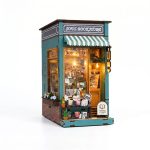
Between books. A general store front reads well as a Book Nook insert because the flat facade mirrors a book spine and the interior depth creates a hallway illusion when flanked by real books. The storefront signage does the work of a title — your eye goes there first. If you’re considering this display style, Book Nook miniature kits cover the specifics of shelf fit and installation.
Standalone on a shelf. LED-lit general stores look strongest in slightly dim rooms — the warm interior glow draws the eye differently than a photo or a book spine. Turn off the overhead light, leave a lamp across the room, and see the difference. The shadows inside the store shift. The jars on the shelf get individual highlights. This is the test I use: leave the room after completing a kit, come back in one minute. If it still looks right from the doorway, it’s ready.
Dust protection. A general store’s open shelving collects dust faster than a closed room scene. A dust cover — sold separately for most kits — keeps the interior props clean. Worth adding to your order upfront rather than realizing it three months later.
Pairing scenes. A general store next to a greenhouse or cottage on the same shelf creates a miniature village corridor. Same scale = believable streetscape. Different scale = different shelf. Measure first.
Frequently Asked Questions
Can I paint the wooden pieces in a miniature general store kit?
Yes — basswood accepts acrylic paint well. Light sanding first helps the paint adhere. Most general store kits come with pre-stained parts or colored paper overlays, so painting is optional customization, not a required step. This is the difference between a miniature construction kit and a miniature painting kit: you’re building structure from laser-cut parts first, painting second if you want to.
How long does it take to build a miniature store kit?
Add 30–40% to the declared time on the box. A kit labeled 6 hours typically takes 8–9 hours across two sessions. Intermediate kits: 4–7 hours. Advanced kits: 8–15 hours. The second session is almost always more enjoyable — glue has set, you’re familiar with the parts, and the later steps (facade, signage, lighting) are the most satisfying.
What battery does the LED light need?
CR2032 button cell. Not included in kits — this is the most common oversight we hear about from buyers. The LED string and wire are included in every Nookcraft kit; you supply the battery. Buy one when you order the kit.
What glue do I need for a miniature general store kit?
Super glue (cyanoacrylate) is recommended for wood joints at this scale. It’s not included in kits. Use a toothpick to control application, especially near LED wire joints — glue seepage into wire connections is the number one cause of LED failure we’ve tracked from buyer reports.
What if a piece is missing or damaged?
Nookcraft offers 30-day returns and free replacement parts for missing or damaged pieces. Email us with your step number and we ship the part. No need to return the whole kit.
If you’re deciding between difficulty levels or figuring out what fits your schedule, start with our beginner kit selection guide to match your first build to your experience and available time →