



Miniature Christmas Tree Kit: What to Look For Before You Buy
Choosing a miniature Christmas tree kit starts with three questions: where will the finished piece live, how many hours can you give it, and is this your first build or your fifth. A Christmas miniature kit could be a single tree diorama or a full holiday house with over 400 pieces. This guide walks through each decision point — scene type, real assembly time, display format, and what’s actually in the box — so you can order the right kit instead of guessing from a thumbnail.
The first question to ask before buying a Christmas miniature kit
Before you compare designs, pin down three criteria: display location, skill level, and available time. This narrows a field that spans from a 60-piece tabletop tree scene to a 500-piece Christmas village diorama.
- Display intent: Where will it go? A bookshelf gap, a desk, under the tree as a gift? This determines whether you need a freestanding kit, a Book Nook insert, or a compact diorama.
- Skill level: Nookcraft rates kits as Intermediate (~4–7 hours) or Advanced (~8–15 hours). If this is your first kit, or you’re buying for a first-time builder, Intermediate with fewer than 250 pieces is the most reliable starting point.
- Available time: In our testing, real assembly time runs 30–40% longer than declared times when you include reading ahead, correcting mistakes, and letting glue set. A kit marked “6 hours” will likely take 8–9. We recommend planning for two sessions — one for the base structure and walls, another for furniture, details, and lighting.
If you’re entirely new to miniature kits, our beginner starter guide to miniature kits breaks down tool lists, difficulty levels, and how to read product specs.
Types of Christmas miniature kits — from standalone tree to full village
The product title often doesn’t tell you what you’re actually getting. Here’s what each category looks like in practice.
| Type | What It Looks Like | Piece Count | Assembly Time |
|---|---|---|---|
| Standalone Christmas tree scene | One or two trees, a bench, a snow-dusted base. Often a tabletop display. | 60–120 | 3–5 hours |
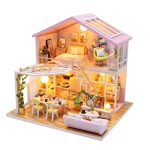
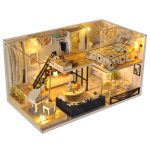
| Christmas house kit | A cottage or shop interior decorated for the holidays — you see the full interior through open walls or a removable panel. | 200–350 | 6–10 hours |
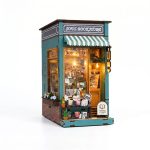
| Christmas book nook insert | A holiday scene designed to fit between books on a shelf, viewed from the side to create a depth illusion. | 150–250 | 5–8 hours |
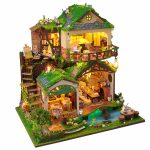
| Christmas village / diorama | A multi-building scene with figures, layered depth, and integrated lighting. The most complex category. | 350–500+ | 10–15 hours |
The piece count tells you more about complexity than the product title does. A “Christmas miniature kit” with 80 pieces is a different project than one with 400. For advanced scene-building, our miniature diorama kit guide covers advanced scene-building in detail. If you’re specifically looking for a shelf insert, Book Nook kits and how to choose one explains the design constraints — like compressing three-dimensional depth into a space defined by how far apart your books happen to be.
Assembly time and difficulty: what to actually expect
We don’t use words like “easy” or “beginner-friendly” because they don’t mean anything specific. Instead, here’s what the numbers look like based on the kits we’ve built and the builders we’ve heard from.
- Intermediate kits: ~4–7 declared hours. Plan for 5–9 real hours across two sessions.
- Advanced kits: ~8–15 declared hours. Plan for 11–20 real hours, best split across three or four evenings.
- Highest-friction steps: In our testing with first-time builders, two steps consistently caused more than ten minutes of confusion: layered roof tile assembly (around steps 47–52 in larger kits) and threading the LED copper wire through anchor holes (step 61). Good instructions should flag these in advance with a warning box.
- The glue-and-LED problem: One buyer’s LED stopped working on day three. We traced it back to glue seeping into the copper wire joint during final assembly. That’s why our instructions now include a callout at step 29: keep glue away from wire ends — contact causes intermittent failure.
If you’re choosing a kit as a gift for someone with no experience, an intermediate-level kit for a first holiday build with fewer than 250 pieces is the safest bet. Completion is likely, frustration is low, and they’ll finish feeling ready for something more complex.
Christmas book nook vs. Christmas house kit: which fits your shelf
The display format changes the entire experience. A book nook insert and a freestanding house kit are built differently, light differently, and live on your shelf differently.
- Book nook: Inserts between books, viewed from the side. The depth is an illusion — every millimeter is designed to create a perspective tunnel. Width is usually 15–18 cm. Measure your shelf gap before ordering. The LED light catches the side walls and creates a warm glow that draws the eye into the scene.
- Freestanding house kit: Sits on top of a shelf or desk. You see the full interior through open walls or a removable panel. The LED light illuminates the interior like a room — furniture, tiny holiday decorations, and all.
- If you’re gifting and don’t know the recipient’s shelf: A freestanding house kit is the safer bet. It works on any flat surface. A book nook needs a specific gap, and guessing wrong means it won’t fit.
For shelf scenes outside the holiday season, miniature greenhouse and floral kits use the same Book Nook format with a different aesthetic.
What’s in the box — and what you’ll need to bring
Most buyer frustration comes from expecting everything included. Here’s the honest breakdown.
Every Nookcraft Christmas miniature kit includes:
- Laser-cut basswood parts with ±0.1mm precision
- LED string with wire, switch, and battery compartment
- Full-color English photo instructions
- Miniature furniture, decorative elements, and any structural pieces
Not included — you’ll need to have:
- Batteries (typically a CR2032 button cell — check the product page)
- Super glue / cyanoacrylate adhesive
- A flat workspace with good overhead light
Our instructions start at step 3. Steps 1 and 2 are desk preparation and parts inventory — the two steps every other manual skips. Taking ten minutes to clear your space and lay out the pieces by number saves an hour of frustration later.
A note on materials: basswood is lighter than MDF, has a visible natural grain, and laser-cuts to tighter tolerances. MDF is heavier with a flat, uniform surface. Nookcraft kits use basswood.
If anything arrives missing or damaged, one email gets a free replacement part shipped. Our 30-day return policy covers the kit itself.
Gifting a miniature Christmas kit: timing and matching
If you’re buying this as a gift, you’re choosing for someone else’s skill level, shelf space, and schedule. Here’s how to match it right.
- For a first-time builder: Intermediate difficulty, under 250 pieces, 4–7 declared hours. This is the range where completion is likely and the process stays engaging.
- For someone with kits already on their shelf: Look at Advanced kits (300+ pieces) or a Christmas Book Nook to complement their collection.
- Timing: Order at least two weeks before the holiday. Assembly takes days, not hours, and you want the recipient to have time to enjoy the process without rushing.
- What to put in the gift box alongside the kit: A CR2032 battery and a small tube of super glue. Nothing kills momentum like opening the kit and realizing you can’t start. A handwritten note with the estimated build time (“This one takes about 7 hours — I’d plan for a Saturday and a Sunday”) is more useful than “Have fun!”
For a complete overview of difficulty tiers and what to expect from each, see all difficulty levels and kit options.
Frequently asked questions
How long does a miniature Christmas tree kit take to build?
Intermediate kits: 4–7 declared hours. Plan for 5–9 real hours, best across two sessions. Advanced kits: 8–15 declared hours. Plan for 11–20 real hours. Don’t trust the time on the box — add 30–40% for reading, correcting, and glue-drying time.
What tools do I need that aren’t included in the kit?
Batteries (usually a CR2032 button cell), super glue / cyanoacrylate adhesive, and a flat workspace with good light. Some builders use tweezers for small parts, but they’re not required.
Can I use a Christmas book nook as a gift if I don’t know the recipient’s shelf measurements?
Book nooks need a shelf gap of at least 15–18 cm. If you’re unsure, a freestanding Christmas house kit is the safer gift — it sits on any flat surface without needing a specific gap.
Are Christmas miniature kits available year-round or only seasonally?
Nookcraft Christmas kits are available year-round. Some buyers build in October for November display, others buy in January for next year. No seasonal stock-out.
What’s the difference between basswood and MDF in miniature kits?
Basswood is lighter, has a natural wood grain, and laser-cuts to tighter tolerances. MDF is heavier with a flat, uniform surface, common in budget kits. Nookcraft uses basswood.
Ready to find the right Christmas kit for your skill level and shelf? Browse our beginner guide to see difficulty breakdowns, tool lists, and kit recommendations by experience level.