



Book Nook Miniatures: A Practical Guide to Choosing Your Next Shelf Scene
You have a gap between two books. Maybe six inches, maybe eight. You’ve been measuring it with your eye for weeks, wondering what belongs there. This guide is about finding the book nook miniature that fits — not just physically, but in terms of your skill, your time, and the scene you want to live with on that shelf.
What Exactly Is a Book Nook Miniature?
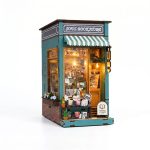
A book nook miniature is a self-contained diorama that slides between books on a shelf. When you look at it from the front, it creates the illusion of a small world opening up behind your bookshelf — an alley, a shop interior, a greenhouse, a library corridor. The sides are enclosed. The front is open. The depth is designed to pull your eye in.
This is the part that matters: a book nook is not just a small house kit. It is a perspective piece. Every element — the floor tiles angling toward a vanishing point, the lamp placed at eye height, the shelf on the back wall that makes the scene feel deeper than it actually is — is built around a single viewing angle. You are looking in from the front, and the scene is built for that one direction.
The physical constraint is your shelf. The vertical gap between your books determines the maximum height and width of the insert. A standard bookshelf gap gives you roughly 6 to 8 inches of width and 8 to 10 inches of height. Every millimeter of perceived depth inside that frame is designed, not found. We let three people who had never built a miniature kit assemble the same Book Nook model. All three got stuck at the same step: layering the background panels to create that forced-perspective depth. The parts weren’t wrong — the instructions were written for someone who already knew what the finished depth was supposed to look like.
That is why Book Nook miniature kits require a different design approach than a standalone miniature house. The space is smaller. The viewing angle is fixed. The illusion has to work from one direction only.
Choosing Your Kit: The Three Decisions That Matter
Before you pick a theme or a color palette, three decisions will shape your experience more than anything else: what the kit is made of, how long it will take, and whether the scene matches what you already have on your shelf.
Decision 1: Material
Most book nook miniature kits use one of two materials:
- Basswood plywood — Light, with a visible natural grain. Laser-cuts cleanly to ±0.1mm precision, which means snap-fit joints line up without forcing. Takes paint if you want to customize the finish. This is what Nookcraft kits use.
- MDF (medium-density fiberboard) — Heavier, smoother surface, no visible grain. More budget-friendly. Cuts well but can chip at edges. Common in kits at lower price points.
The difference you will notice during assembly: basswood pieces flex slightly without snapping, which helps when you are fitting curved elements like archways or window frames. MDF is stiffer. If a joint does not line up on the first try, MDF is less forgiving.
Decision 2: Difficulty and Time
We label kits in two tiers: Intermediate (~4–7 hours) and Advanced (~8–15 hours). These numbers assume focused building, not the kind where you stop to check your phone every ten minutes.
Here is the part most product pages leave out: the declared time is usually the fastest a competent builder could go if nothing went wrong. We add 30–40% and tell buyers to plan for two sessions, not one. The second session is almost always more enjoyable — the main structure has set, the glue has cured, and you are no longer rushing to see if the thing holds together. If this is your first miniature kit, our beginner miniature house kit guide covers what to expect before you open the box.
Decision 3: Scene and Scale
Does the theme belong on your shelf? A fantasy alley might feel out of place next to a row of memoirs. A miniature greenhouse might be exactly right next to your gardening books. Think about what you see when you stand in front of that shelf — the colors, the spines, the mood — and choose a scene that extends that world rather than contradicting it.
Scale matters if you already own miniatures. A 1:24 Book Nook next to a 1:12 dollhouse piece will look inconsistent. Most Book Nook kits use 1:24 scale (half-inch equals one real foot), which keeps the insert compact enough for standard shelves.
Match the Scene to Your Shelf: Kit Ideas by Theme
The scene you choose says something about the shelf it lives on. Here are four directions, each described by what you would actually see looking in through the front opening.
The Cozy Bookshop or Library
A narrow corridor lined with book spines. A reading lamp casting warm light on a small desk. Maybe a ladder leaning against one wall. This is the meta-scene — the miniature that comments on the books surrounding it. If your shelf is heavy on fiction, this one feels like it has always been there. Browse our miniature bookstore and library kits for options ranging from Victorian reading rooms to modern indie shop interiors.
The Miniature Greenhouse or Botanical Studio
Green-tinted light through glass panes. Terracotta pots on a wooden bench. A watering can on the floor. This scene brings color to a shelf in a way that wood-tone interiors cannot. It pairs well with nature writing, gardening books, or a shelf that leans into cottagecore and botanical aesthetics. The plant details are some of the smallest pieces in any kit — plan extra time for these steps.
The Fantasy Alley or Mystical Portal
Stone walls converging toward a vanishing point. A lantern hanging from a bracket. Maybe a doorway at the back that glows. This is the scene that uses LED lighting most aggressively — the light is not decorative, it is structural, creating depth where the physical depth ends. Good for sci-fi and fantasy shelves. The key design element is the back wall: if it is placed correctly, the scene looks three feet deep. If it is off by even a millimeter, the illusion breaks.
The Urban Coffee Shop or Apothecary
A counter with tiny bottles. A menu board on the wall. Two stools. This scene feels like a place you have been, shrunk down and hidden in your shelf. It works on a living room shelf, a kitchen shelf, or a home office — anywhere you want a small pocket of a different kind of quiet.
What’s in the Box and What You’ll Need
Every Nookcraft kit includes:
- Laser-cut basswood parts, labeled and sorted by assembly stage
- An LED string light with wire and battery compartment
- Full-color English photo instructions with step-by-step close-ups
- Spare parts for the most fragile components
You will need to supply:
- Wood glue — we recommend cyanoacrylate (super glue) for its fast bond on wood joints. It is not included in the kit.
- Two CR2032 button cell batteries — for the LED. Also not included. This is the item buyers forget most often.
- A craft knife or fine sandpaper — for minor cleanup on laser-cut edges. Most pieces need none, but a few will.
FAQ: Common Questions from First-Time Builders
What’s the difference between a Book Nook and a regular miniature house kit?
A Book Nook is designed as a shelf insert with a specific viewing angle — you look in from the front, and the scene is built for that one direction. A miniature house kit is often a standalone, fully enclosed structure you can view from multiple sides. The Book Nook’s constraint is the gap between your books; every design decision flows from that space.
Are book nook miniatures suitable for beginners?
Our kits are rated Intermediate or Advanced. We do not sell kits labeled “easy” or “beginner” because that language sets the wrong expectation. If you can follow a recipe with more than ten ingredients and you have patience for small parts, you can build an Intermediate kit. Plan for two sessions. The beginner guide covers tools, mindset, and what to expect before you start.
Is it hard?
Intermediate kits take 4–7 hours. Advanced kits take 8–15 hours. The difficulty is not in the complexity of any single step — it is in maintaining attention across many small steps. We let three first-time builders test our kits and tracked where they got stuck for more than ten minutes. The same two spots came up every time: roof tile layering and threading the LED wire through anchor points. Both are solvable with the right instruction callout, which is why those sections now have extra diagrams.
How long will it really take?
Add 30–40% to our estimated time. The second session is usually more productive and more enjoyable than the first — the main structure is set, the glue has cured, and you can focus on the details that make the scene feel lived-in.
What if I break or lose a piece?
We include spare parts for the most fragile components in every kit. For anything else — missing pieces, damaged parts, pieces that did not survive the first attempt — we offer free replacements within 30 days of purchase. Email us with the step number and a photo.
What type of glue works best?
Cyanoacrylate (super glue). It bonds fast on wood, which is important when you are holding a small piece in place with one hand. It is not included in any Nookcraft kit — you will need to buy it separately. Apply sparingly. Excess glue on the LED wire joints can cause the light to fail after a few days.
Can I paint or modify the kit?
Yes. Basswood takes acrylic paint well. We design with some room for customization, though altering the structure — trimming a wall panel, repositioning a staircase — may affect how adjacent pieces fit together. If you plan to paint, do it before assembly where possible.
Ready to choose a scene for your shelf? Explore our full collection of Book Nook miniature kits to find the right theme and difficulty for you →