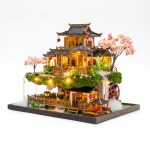



Best Miniature House Kits for Adults: Choosing a Kit That Fits Your Shelf, Skill, and Weekend
When I search for the best miniature house kits for adults, I get a wall of star ratings and product photos that start looking identical by the third scroll. The kits differ by maybe $8 and a lot of decorative language. None of that tells me what I actually need to know: Will the parts fit? Will the instructions make sense at step 47? How many evenings is this really going to take?
If you’re reading this, you’ve probably already decided you want to build something. What you need is a way to compare kits that goes beyond thumbnail images. This guide breaks down the five specs that matter—and how to match them to your shelf space, your free time, and your patience.
What “best” actually means when you’re buying a miniature kit
“Best” is a word that loses meaning fast. The best miniature house kit for someone who has built six dollhouses and wants a new challenge is not the best kit for someone whose last craft project was a paint-by-numbers three years ago.
Instead of chasing the highest-rated product, look at three measurable specifications:
Material. Basswood plywood is light, has visible grain, and takes paint or stain well. MDF (medium-density fiberboard) is heavier, cheaper to produce, and gives a uniform surface that looks less like wood. Both can produce a finished model, but the building experience and the final result feel different in your hands.
Precision. “Laser-cut” appears on most kit listings now, but not all laser-cutting is equal. Tolerances of ±0.1mm mean joints snap together without forcing. Wider tolerances mean you’re sanding, adjusting, or getting frustrated at step 12.
Instruction design. This is the one nobody talks about until they’re stuck. A good instruction set shows you exactly what changed between step 22 and step 23. A bad one reuses the same photo with a red circle that could mean three things. Look for full-color, English-language photo instructions—specifically ones that show tricky steps like LED wiring from more than one angle.
| What to check | Why it matters to your hands and your shelf |
|---|---|
| Basswood vs. MDF | Basswood is lighter, shows grain, and bonds cleanly. MDF is heavier with a flat, uniform surface. |
| Laser-cut tolerance (±0.1mm) | Tight tolerances mean parts interlock without sanding or forcing—fewer mid-build frustrations. |
| Instruction language and format | Full-color English photo instructions reduce guessing. Numbered steps with callout arrows cut down on “what changed here?” moments. |
| Declared build time | Compare stated hours against part count. A 300-piece kit claiming 3 hours is underestimating. |
| Included components (LED, hardware) | Check whether LED string and wiring are in the box. Batteries and glue are almost never included. |
Designing a Book Nook is harder than designing a full house kit of the same size—not because the pieces are more complex, but because you’re compressing three-dimensional depth into a space defined by how far apart someone’s books happen to be. Every millimeter of perceived depth is designed, not found. That constraint is what makes the best miniature kits for adults worth comparing carefully.
You can read more about adult craft kits for stress relief and gifts if you’re buying for someone else or looking for a project that gives you a screen-free focus block.
Five criteria to evaluate before you add a miniature house building kit to your cart
Here’s the checklist I’d use if I were buying a kit from a brand I’d never heard of.
1. Material: Basswood vs. MDF
Basswood plywood weighs less, shows natural grain, and holds paint without bubbling. MDF is denser, cheaper to produce, and gives a uniform surface. If you plan to paint your kit, either works. If you want the wood to look like wood, basswood is the material to look for.
2. Precision: Laser-cut tolerances
“Laser-cut” is not a quality guarantee—it’s a manufacturing method. What matters is the tolerance. ±0.1mm means a slot is exactly the width of the tab that goes into it. ±0.5mm means you’ll be adjusting with a craft knife. Look for listings that specify tolerance, not just the cutting method.
3. Instructions: Full-color, English, photo-based
Based on the kits we’ve tested, the most common point where builders get stuck isn’t a complex step—it’s a step where the instruction image doesn’t clearly show what changed from the previous one. Full-color photos with numbered callout arrows solve this. Line drawings and grayscale images cost less to print, and you pay the difference in frustration.
4. Declared vs. realistic assembly time
We track build times. The declared time on a kit is usually the fastest a competent builder could go if nothing went wrong. In practice, add 30–40%. A kit labeled “4 hours” will take closer to 5.5 or 6. A kit labeled “8 hours” is best split across two sessions—the second session is almost always better because the glue from session one has set and you’re not rushing.
5. What’s in the box
Most kits include: laser-cut wood parts, paper or fabric accessories, LED light string with wire, and printed instructions. Most kits do not include: glue (you’ll need super glue, not wood glue) or batteries (usually CR2032 button cells). Check before you order, because nothing stalls a build faster than reaching the wiring step and realizing you don’t have a battery.
For dollhouse-style kits for adults with multiple rooms and staircases, expect longer build times and more structural assembly.
Matching a kit to your available time and skill
This is where most buying guides stop at “beginner, intermediate, advanced” labels and leave you guessing. Here’s a more specific way to decide.
You have one uninterrupted Saturday (6–8 hours free):
Look for kits labeled Intermediate with around 250–300 pieces. These usually involve a single-room scene—a café, a library corner, a garden greenhouse. The scope is manageable, and you can finish in one sitting if you start early and take short breaks.
You prefer two shorter sessions (3–4 hours each):
Plan this for any kit over 7 declared hours. Use session one for structural assembly—walls, floors, major furniture. Use session two for details, wiring, and finishing. The break between sessions isn’t wasted time. The glue cures fully, and you come back with fresh eyes. In our experience, the second session produces fewer mistakes.
You’ve never built a miniature kit before:
Start with a scene, not a full multi-room dollhouse. A Book Nook—a miniature insert that fits between books on a shelf—teaches you spatial assembly, LED wiring, and detail work in a contained format. You’re building one world, not ten rooms. If you want inspiration for your first scene, browse miniature house design ideas to see what themes and aesthetics match your shelf.
Your last craft project was months (or years) ago:
Choose a kit with fewer than 300 parts and an honest difficulty label. Intermediate means there will be steps that require patience—not that you need prior experience. What you need is clear instructions, and that’s something to verify before buying.
Common pitfalls and how to avoid them
After hearing fromAfter hearing from builders who contacted us after getting stuck—or after a piece broke—I can point to four mistakes that come up again and again. All four are preventable.
The second most common question we get from new buyers isn’t about a broken piece. It’s: “I got to step 23 and I can’t tell what changed from step 22.” That’s an instruction problem, not a user problem. If you’re comparing kits, look at sample instruction pages if the listing shows them. A clear step image saves you ten minutes of guessing.
Where to go next: Finding your first (or next) build
You’ve got the criteria. Now match them to what you actually want on your shelf.
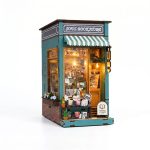
For bookshelf integration: Book Nooks. These miniature scenes fit between books on a shelf and create the illusion of a world behind the bookcase. They use vertical space, so they don’t take up desk or table room. Good for: apartment shelves, shared living spaces, anyone who wants a finished piece that lives among their books rather than on a separate display surface.
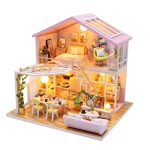
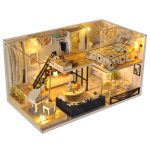
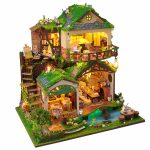
For a classic multi-room feel: Dollhouse-style kits. These are standalone structures with multiple rooms, staircases, and sometimes exterior details. They take longer to build—often 10–15 hours—but the result is a piece with more visual complexity. Good for: builders who want a longer project, display on a mantle or dedicated shelf, and the satisfaction of wiring multiple rooms.
For a focused, single-session project: Scene kits. A café, a library corner, a flower shop. One room, one story, one weekend. These kits offer a complete experience in a manageable scope. Good for: first-time builders, anyone testing whether this hobby sticks before committing to a 15-hour build, or a gift for someone you’re not sure will love it as much as you think they will.
Browse miniature house kits for adults to compare by theme, difficulty level, and estimated build time.
Frequently asked questions
Do miniature house kits come with glue or batteries?
Most do not. A typical kit includes laser-cut wood parts, paper or fabric accessories, an LED light string with wire, and printed instructions. What you’ll need to supply separately: super glue (cyanoacrylate) and batteries—usually CR2032 button cells for Book Nook kits or AA batteries for larger house kits. Check the product page before ordering so everything arrives before you’re ready to start.
How long does it really take to build a miniature kit?
Intermediate kits take 4–7 hours of active building time. Advanced kits take 8–15 hours. These are real hours, not the optimistic numbers some boxes print. We recommend adding 30–40% to whatever time is listed. For any build over 7 hours, splitting across two sessions works better—the first session handles structure, the second session handles details and wiring when you’re not rushing.
What’s the difference between a Book Nook and a dollhouse kit?
A Book Nook is a miniature scene designed to slide between books on a shelf. Viewed from the side, it creates the illusion of a corridor, room, or world extending behind your bookcase. A dollhouse kit is a standalone structure—usually multi-room with a facade, roof, and sometimes exterior details. Book Nooks focus on perspective and depth within a confined vertical space. Dollhouses focus on architectural completeness. The building experience is different: Book Nooks require more attention to forced perspective; dollhouses require more structural planning.
I’m new to crafting. Is a miniature kit too hard?
Difficulty labels exist for a reason—but they’re not always honest. “Easy” on some kits means “you’ve done this before.” Look for kits labeled Intermediate with fewer than 300 parts and a single-room theme. These offer enough complexity to be satisfying without requiring prior experience. What matters most for a first build isn’t the difficulty label—it’s the quality of the instructions. Full-color English photo instructions with clear step transitions make the difference between a frustrating afternoon and a finished piece you’re proud to put on your shelf.
Ready to start your next build? Browse kits by difficulty, theme, or time commitment →